Flat Roof Problems Explained
By RoofEnquiry Editorial · Updated 10 February 2026 · 10 min read
Quick answer
- Flat roofs aren't actually flat — they're built with a slight fall, and most problems start when that fall stops working properly.
- Ponding water (standing for more than 48 hours after rain) is the most common early sign of trouble.
- Material matters: felt, GRP fibreglass and EPDM rubber age differently and have different typical lifespans.
- Blocked outlets are often the simplest and cheapest cause to fix — always worth ruling out before assuming membrane damage.
Flat roofs aren't actually flat
The name is slightly misleading. Every properly built flat roof has a shallow fall — usually somewhere around a 1:40 to 1:80 slope — built into the structure so rainwater drains towards an outlet or gutter rather than sitting where it lands. Most flat roof problems trace back to that fall being insufficient, damaged, or blocked at the point it's supposed to drain.
It's also worth knowing, roughly, what's underneath the visible surface. A typical flat roof build-up is a deck (timber boards or similar), insulation, and then the waterproof covering on top — sometimes with a vapour control layer beneath the insulation to manage moisture from inside the building. None of that is essential detail for a homeowner to memorise, but it explains why flat roof problems aren't always just about the top layer: insulation that's become damp, or a deck that's started to sag slightly, can affect the surface above it in ways that look like a covering problem but actually start further down.
Flat roofs are extremely common in the UK on a specific category of structure: single-storey extensions, garages, dormer tops, and porches, where a pitched roof would be structurally awkward or would block a window above. On these smaller, simpler structures, flat roofing is often the practical and cost-effective choice rather than a compromise — the reputation flat roofs sometimes have for being problematic usually traces back more to installation quality and material age than to flat roofing being inherently inferior to pitched.
Some older properties do have a fully flat-roofed main structure too, particularly certain mid-20th-century designs, which is a slightly different situation to a small extension roof simply because of the larger area involved and correspondingly larger consequences if drainage or the covering does fail.
Whichever category your flat roof falls into — a small extension, a garage, or a full main roof — the underlying principles in this guide apply equally. Scale changes the consequences of a problem and sometimes the cost of fixing it, but not really the nature of what tends to go wrong or why.
Ponding water
Ponding is the term for water sitting on the roof surface rather than draining away. A small amount of temporary ponding after heavy rain isn't unusual and generally isn't a concern on its own. Water that's still visibly sitting there more than about 48 hours later, though, points to a drainage or fall problem, and prolonged ponding accelerates wear on whatever material is underneath it — UV degradation and freeze-thaw cycling both do more damage to a wet membrane than a dry one.
Comparing the common flat roof materials
Three materials cover the large majority of UK flat roofs, and knowing which one you have is genuinely useful context before getting a repair quote, since the right fix and its cost both depend heavily on the covering type.
Flat roof covering materials compared
| Material | Typical lifespan | Common failure signs | Notes |
|---|---|---|---|
| Felt (bitumen, torch-on or pour-and-roll) | 10–20 years | Blistering, cracking, lifted seams, granule loss | The most traditional and often most affordable option; quality varies significantly by number of layers and installation |
| GRP (fibreglass) | 20–30 years | Cracking ("crazing"), edge trim failure | Forms a seamless rigid surface; repairs generally need matching resin work |
| EPDM (rubber membrane) | 25–50 years manufacturer-rated, commonly 20–30 in practice | Seam separation, punctures, shrinkage at edges | Single-sheet or seamed depending on roof size; widely used on modern extensions |
Lifespans are general industry indicators and assume reasonable installation quality and maintenance — actual performance varies. See our roof lifespan guide for more on this.
If you're not sure which material your roof has, that's a perfectly normal thing not to know — it's usually easy for a roofing professional to identify from a couple of photos or a quick look.
Membrane and covering damage
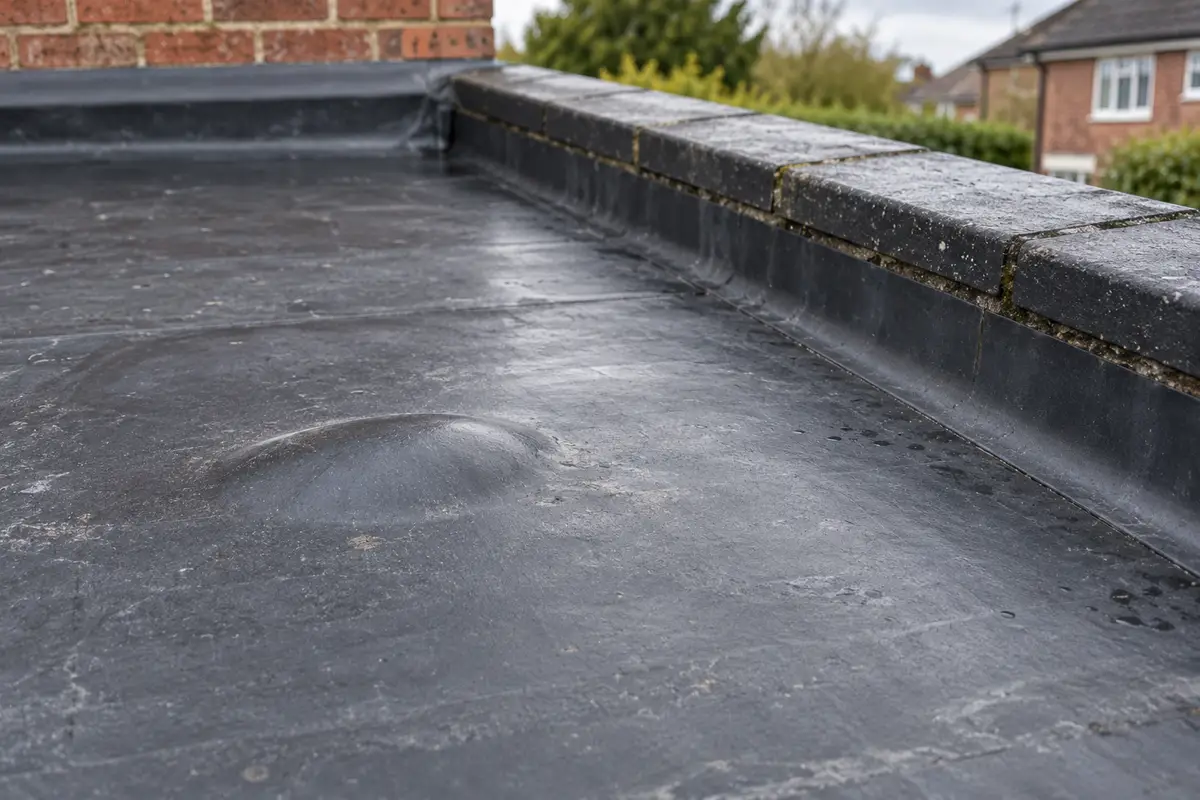
All three materials above degrade eventually through a combination of UV exposure, temperature swings, and general weathering — the question is really just when, not if. Cracks, blisters and lifted seams are the classic visible signs that a covering is reaching the end of its useful life, as opposed to just having a one-off, localised fault.
- Blistering — small raised bubbles, often where moisture has become trapped beneath the surface.
- Cracking — particularly common on felt and GRP as they age and lose flexibility.
- Lifted or open seams — where two sections of covering meet, often the first point of failure on felt and EPDM roofs.
- Granule loss (felt specifically) — the protective top layer wearing away, leaving the underlying bitumen more exposed to UV.
None of these signs necessarily mean the whole roof needs replacing immediately — a single small blister, for instance, is often a straightforward, localised repair. It's the combination of several signs appearing together, or across a wide area, that more strongly suggests the covering as a whole is reaching the end of its working life rather than dealing with an isolated fault.
If you're not confident distinguishing between these from a photo yourself, that's completely normal — describing what you can see (a bubble, a crack, a dark patch, something lifted at an edge) in plain terms is exactly what's needed, and identifying which category it falls into is part of what a roofing professional's assessment covers. Our guide on what information to give a roofer has a section specifically about describing flat roof problems clearly.
Timing also matters here. A blister or crack noticed early, while it's still small and isolated, is a considerably simpler and cheaper fix than the same problem left to spread across a wider area — which is really the central theme running through this whole guide: flat roof problems are generally very manageable when caught early, and considerably less so when left.
Drainage and outlets
Blocked or damaged outlets are one of the most common — and most straightforward to fix — causes of flat roof water problems. Leaves, moss and general debris collect at the lowest point of the roof exactly where the outlet sits, and a blocked outlet has the same effect as a blocked bath plug: water backs up and sits, whatever the covering underneath is doing. This is always worth ruling out before assuming the membrane itself has failed, since clearing an outlet is a much smaller job than repairing or replacing a covering.
It's also worth checking that guttering connected to the flat roof is clear, since a blocked downpipe further along the system can cause water to back up onto the roof itself.
Installation quality matters more on flat roofs than most people expect
Pitched roofs are somewhat forgiving of minor installation imperfections, because gravity is doing most of the work moving water quickly off a steep slope. Flat roofs have far less margin for error — insufficient fall, poorly formed upstands at walls and edges, or a covering not properly bonded at joints and edges can all lead to problems years before the material itself would otherwise have failed. This is one reason a flat roof's actual lifespan in practice sometimes falls short of a manufacturer's rated figure: the covering itself was fine, but how it was installed wasn't.
It's also why, when getting a flat roof repaired or replaced, the quality of the installer's workmanship arguably matters more than the specific material brand chosen — a well-installed felt roof can outperform a poorly installed EPDM one, even though EPDM is generally the more durable material on paper.
This is also why two seemingly identical flat roofs on similar extensions, built around the same time, can age at noticeably different rates. The material and its rated lifespan only tell part of the story — the fall gradient achieved on the day, how carefully the upstands and edge trims were formed, and how well the joints were bonded all play at least as large a role in how long the roof actually lasts in practice.
Choosing someone to work on a flat roof
Flat roofing is something of a specialism within roofing more broadly — the materials, detailing and common failure points differ enough from pitched roof work that experience specifically with flat roofs is genuinely worth asking about. It's a reasonable question to ask directly: how much of their recent work has been flat roofs specifically, and with which of the common materials (felt, GRP, EPDM).
- Ask what material they'd recommend for your specific roof and why, rather than accepting a single option without explanation.
- Ask how they handle upstands, edges and outlets — these detail points are where flat roofs most commonly fail, so it's worth knowing they're being taken seriously.
- Ask about warranty specifics for flat roof work, since manufacturer warranties on materials like EPDM are often contingent on correct installation by an approved installer.
Repair or replace?
A localised problem — one blister, one lifted seam, one cracked area — can often be patched without redoing the whole roof. Widespread issues across most of the surface, or a covering that's clearly at or past its typical lifespan, more often point towards a fuller replacement being the more sensible long-term option, since patching an already-failing membrane in multiple places tends to just delay the same conversation.
A useful rough guide: if you can count the problem areas on one hand and they're spread out rather than clustered, patching is often reasonable. If the whole surface shows a consistent pattern of ageing — widespread minor cracking, granule loss across the board, multiple seams starting to lift — that's a stronger signal that you're looking at the covering reaching end of life generally, not a handful of isolated faults.
UK weather adds a seasonal dimension worth knowing about too. Winter freeze-thaw cycles — water getting into small cracks, freezing, expanding, and widening them — tend to make existing minor damage noticeably worse over a cold spell, which is why flat roof problems are often first noticed, or first get significantly worse, during or just after winter. Summer heat, meanwhile, can cause its own issues, particularly softening and movement in older bitumen felt roofs on unusually hot days.
Simple maintenance that extends a flat roof's life
None of this needs specialist tools or knowledge — the habits below are all things a homeowner can reasonably do themselves, without accessing the roof surface directly.
- Clear leaves, moss and debris from the surface and outlets a couple of times a year, particularly in autumn.
- After checking it's safe and dry to do so from a safe vantage point (an upstairs window is often enough), look for standing water a couple of days after rain.
- Trim back any overhanging branches that regularly drop debris or create shade that keeps the surface damp for longer than it otherwise would be.
- Avoid using a flat roof as informal storage or walking on it unnecessarily — foot traffic is a common, avoidable cause of early wear, particularly on felt and EPDM.
- Have it looked at by a professional periodically, especially once it's more than halfway through its material's typical lifespan.
A note on cost
Flat roof repair and replacement costs follow similar general patterns to pitched roofs — small patch repairs at the lower end, full recovering considerably more — with the specific material chosen being one of the bigger factors, since EPDM and GRP materials and their specialist fitting generally cost more than felt, reflecting their longer typical lifespan. Our roof repair cost guide covers general UK price ranges in more detail, including flat roof-specific figures.
Getting a flat roof assessed
If you're dealing with any of the signs above, describing what you've noticed — including roughly how long it's been happening and any photos of the affected area — gives a roofing professional a genuinely useful starting point before they've even visited.
Frequently Asked Questions
Is a small amount of ponding water always a problem?+
Not necessarily — brief ponding after heavy rain is common. Water still sitting after 48 hours or longer is the point at which it's worth having checked, since prolonged ponding accelerates wear on the covering.
Can a flat roof be repaired without full replacement?+
Often, yes, if the damage is localised. Widespread or repeated problems across the same roof are more likely to point towards a fuller replacement being the better long-term option — a roofing professional can advise based on an in-person look.
How do I know what material my flat roof is?+
Felt often has a slightly granular, matte surface; GRP is a smooth, rigid, often slightly glossy surface; EPDM is a smooth black rubber sheet. If you're unsure, a photo is usually enough for a roofing professional to identify it.
Do flat roofs need more maintenance than pitched roofs?+
Generally, yes — clearing debris from outlets and checking for ponding is worth doing more regularly on a flat roof than the equivalent ground-level checks for a pitched roof, simply because flat roofs are more directly affected by drainage issues.
Is EPDM always better than felt?+
EPDM generally has a longer typical lifespan and is often more resistant to UV degradation, but installation quality matters enormously for both materials. A well-installed felt roof can perform better in practice than a poorly installed EPDM one.
Can I walk on my flat roof to check it myself?+
It's best avoided where possible — foot traffic can itself cause wear on some coverings, and there are obvious fall risks. Checking from a safe vantage point such as an upstairs window is generally the better approach for a homeowner.
Why does my flat roof extension leak more than the rest of the house?+
Flat roofs generally have a shorter typical lifespan than pitched roof coverings and are more sensitive to installation quality and drainage issues, which is why extensions with flat roofs sometimes need attention more often than the main pitched roof of the same property.
Can a flat roof be converted to a pitched roof?+
Structurally, it's sometimes possible, but it's a significantly bigger project than a repair or recovering, involving structural changes and typically requiring planning permission. It's worth discussing with a roofing professional if this is something you're considering.
Is a flat roof always a sign of a cheaper or lower-quality build?+
No — flat roofs are a deliberate, practical choice for many structures (extensions, garages, dormers) regardless of the overall property's quality, and modern materials like EPDM can perform very well when properly installed.
Why does my flat roof problem seem worse after winter specifically?+
Freeze-thaw cycling — water in small cracks freezing and expanding — tends to worsen existing minor damage over a cold spell, which is why flat roof issues are often first noticed, or noticeably worsen, during or just after winter.
Is a green (living) roof the same as a standard flat roof?+
A green roof sits on top of a standard waterproof flat roof build-up, with planting and growing medium added above it. It requires the same underlying membrane and drainage principles, plus additional considerations around weight and root protection — worth mentioning specifically if this applies to your property.