Roof Windows & Skylights Explained: Leaks, Installation and Common Problems
By RoofEnquiry Editorial · Updated 24 September 2026 · 10 min read
Quick answer
- Skylights and roof windows leak disproportionately often compared with the surrounding roof, because the perimeter cut into the covering is exactly where problems tend to start.
- A failed flashing kit or a perished seal is the most common cause of a skylight leak — not a fault with the roof around it.
- Condensation on the inside of a skylight is extremely common and isn't usually a leak, but the two get confused often enough to be worth telling apart properly.
- Older single-glazed units (roughly 15 years or more) more often make sense to replace outright than to keep resealing individually.
A small feature with a disproportionately large reputation for leaks
Skylights and roof windows make up a tiny fraction of most roofs by surface area, and yet they show up again and again as a source of leaks — often before anything else on the roof has given any trouble at all. That's not a coincidence, and it's not usually a sign of a badly built roof either. It's simply what happens when you cut a hole in a continuous waterproof surface and rely on a much smaller, more complex junction to keep doing the same job.
This page covers what actually makes skylights and roof windows different from the rest of the roof, why they fail in specific, predictable ways, how to tell a skylight leak apart from ordinary condensation, and what's worth knowing if you're considering installing one — whether as part of a loft conversion or simply to bring more light into a room.
Roof windows, skylights and roof lanterns: what's the difference
The three main types found on UK homes
| Type | Where it's found | What makes it distinct |
|---|---|---|
| Roof window | Set flush into a pitched roof, following the same slope as the surrounding tiles or slates | Modern versions (Velux and similar) come with a manufacturer-matched flashing kit designed for a specific roof covering — the most common type fitted today |
| Traditional skylight | Also set into a pitched roof, but raised slightly above the roof plane rather than flush with it | More common on older properties; often single-glazed with simpler, less integrated flashing than a modern roof window |
| Roof lantern | Sits on a flat or low-pitch roof, usually as a raised glazed structure with its own small upstand | A different set of problems again — closer to the flat roof issues covered in {{guide:flat-roof-problems-explained|our flat roof guide}} than to pitched-roof skylight problems |
The general principles on this page apply to all three, though the specific failure points differ — flagged separately further down.
Why skylights leak more often than the roof around them
Every skylight or roof window installation involves cutting a gap into what would otherwise be a continuous waterproof surface, and then relying on a much smaller system — flashing, seals, and drainage channels built into a relatively small frame — to do the job that the roof covering does over every other square metre. That system has far less margin for error, and far more individual components that can each fail on their own.
- A tile or slate roof sheds water in a simple, repeating pattern across a huge area; a skylight interrupts that pattern and needs its own dedicated system to redirect water around it instead.
- The flashing kit around a skylight is doing concentrated work that a much larger area of ordinary roof covering shares between many overlapping tiles or slates.
- Rubber seals and gaskets — present on most skylights in some form — degrade with UV exposure and age faster than the tiles or slates around them, which don't rely on rubber at all.
- A skylight is also a common point where two different trades' work meets (the roofer and whoever fitted or specified the window), which occasionally means a gap in exactly whose responsibility the junction was during the original installation.
Exposure plays a part too. A skylight on a slope that faces the prevailing wind and rain — commonly a south-westerly aspect in most of the UK — is doing that concentrated work under harder conditions than an identical unit on a more sheltered slope of the same roof. This is one reason two skylights on the same house, fitted at the same time by the same installer, can age at noticeably different rates; it's rarely a sign that one was fitted badly and the other wasn't.
Signs of a skylight or roof window problem
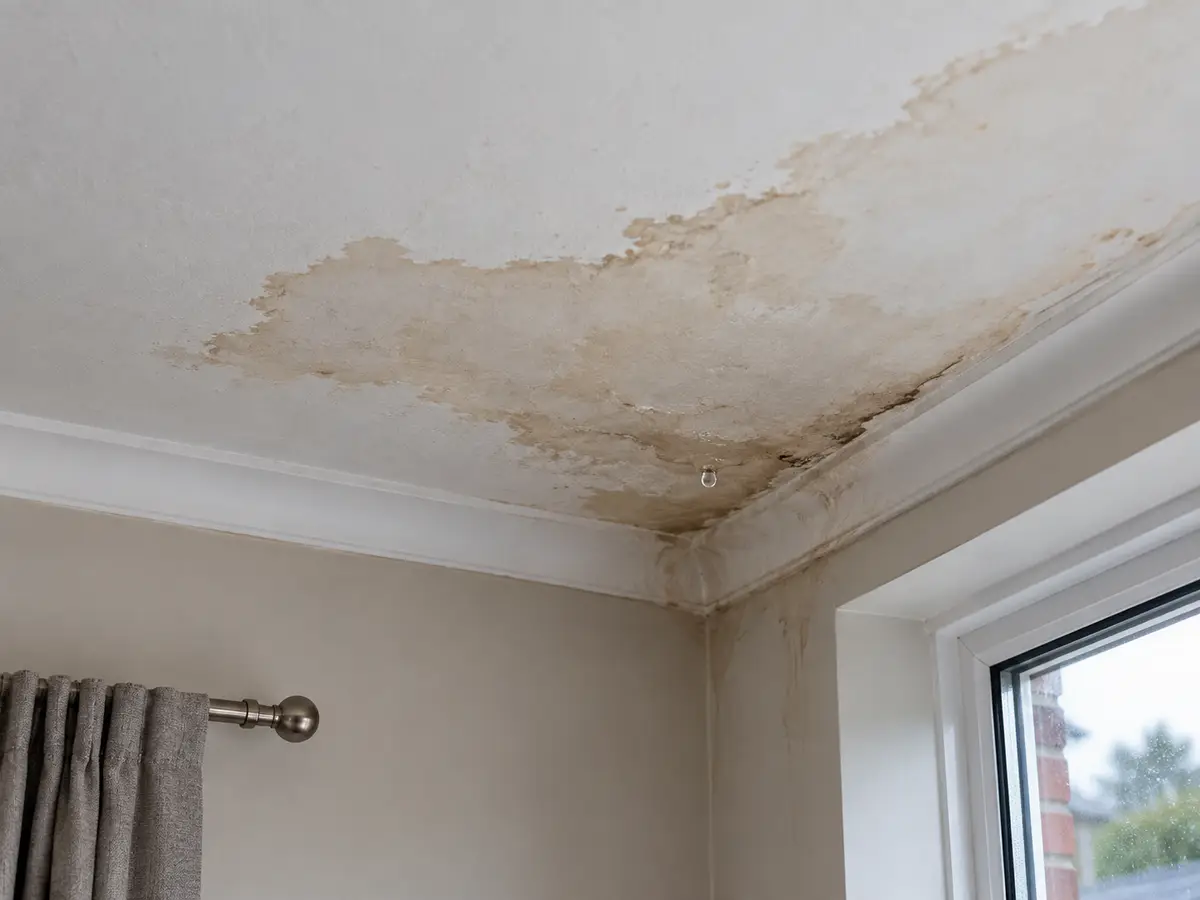
- Staining or a damp patch on the ceiling or wall directly around the skylight frame, particularly worse during or shortly after rain
- Visible daylight or a draught around the edge of the frame from inside
- Water pooling on the internal sill, especially after heavy or wind-driven rain
- Cracked, perished or missing sections of the rubber seal around the glazing
- Staining or a green tinge on the external flashing, or flashing that's visibly lifted or damaged
- Condensation that seems unusually heavy or persistent compared with other windows in the property
As with the rest of the roof, our general leak guide covers what to do about active water ingress. The main thing worth doing differently with a skylight is checking whether the water is actually coming from around the frame itself, or tracking down from higher up the roof and simply becoming visible at the skylight — the two point towards very different fixes.
Condensation vs a genuine leak, on a skylight specifically
This distinction matters even more for skylights than it does for the rest of the roof, because a skylight is exactly the kind of cold surface — set into an otherwise warm ceiling, often above a bathroom or bedroom — where warm, moist household air is most likely to condense. Our loft ventilation guide covers the general mechanics of this in more depth, and the same principle applies directly here.
It's genuinely common for a homeowner to notice water around a skylight, assume the worst, and book an expensive repair — only to find the glazing and flashing are both sound, and the actual issue is condensation from a bathroom extractor fan or simply poor airflow in that part of the loft or room. Worth ruling this out before assuming the skylight itself has failed.
The most common actual causes of a skylight leak
- A failed or incorrectly fitted flashing kit — by far the most common cause, and one that can develop years after an otherwise fine installation as materials age and settle
- Perished rubber seals or gaskets, particularly on units more than 10–15 years old, or on units that used a generic rather than manufacturer-specific flashing kit
- A blocked drainage channel at the base of the frame, where the skylight's own small drainage system is meant to direct any incidental water back outside rather than let it pool
- Debris, moss or leaves collecting around the upper edge of the skylight and disrupting how water flows around it — worth checking alongside any wider moss build-up on the roof
- The original installation itself, if the wrong flashing kit was used for the roof covering, or the unit wasn't correctly sized and sealed into the opening cut for it
Repair, reseal, or replace the whole unit?
A single failed seal or a localised flashing problem on an otherwise sound, reasonably modern skylight is usually a straightforward repair — resealing or replacing the affected section rather than the whole unit. This is broadly the same logic as repairing a single guttering fault rather than replacing an entire system over one localised issue.
Older single-glazed skylights, particularly ones nearing or past the 15-year mark, are a different conversation. Seals and gaskets don't age gracefully on their own — once one has perished, others fitted at the same time are usually not far behind, and a pattern of repeated small leaks across a few years often ends up costing more than a single replacement with a modern, better-sealed unit would have. Double-glazed roof windows with integrated flashing kits also tend to perform noticeably better on both weatherproofing and heat loss than the units they're commonly replacing.
If a roofing professional identifies the flashing kit itself as the problem rather than the glazing, that's generally good news — flashing can usually be replaced without disturbing or replacing the window unit itself, provided the frame and seals around the glass are otherwise sound.
It's worth asking specifically whether any replacement uses a manufacturer-matched flashing kit for your roof covering, rather than a generic universal version — the difference in cost is usually modest, but the difference in how reliably it seals against your specific tile or slate profile is not, and it's a detail that's far easier to get right the first time than to revisit a year later.
Installing a new roof window or skylight
Adding a skylight, whether as a standalone project or as part of a wider loft conversion or re-roof, involves a few considerations beyond simply choosing a window and a spot for it.
- Structural work — cutting an opening in a roof usually means adding trimmers around the gap to support the rafters either side of it, which is structural work rather than a simple fit-and-seal job.
- Matching the flashing kit to the roof covering — flashing kits are generally designed for a specific tile or slate profile, and using the wrong one for your roof covering is one of the more common causes of a leak developing later.
- Planning permission — many roof window installations fall under permitted development, but this can depend on the property, its height, and whether it's in a conservation area, so it's worth checking with your local authority before committing, similar to the planning considerations covered in our roof replacement guide.
- Position and purpose — a skylight fitted primarily for light does a different job to one intended to open for ventilation, and the two aren't always interchangeable once installed.
Roof covering also matters more than it might seem. A flashing kit designed for a flat, thin material like slate sits and seals differently to one designed for a thicker, profiled interlocking tile, and manufacturers generally produce distinct kits for each rather than one generic version that fits everything reasonably well. Reusing or improvising a flashing kit designed for a different covering than the one actually on your roof is a recognised cause of leaks that can take months or years to show up, since the mismatch is often subtle enough not to fail immediately.
It's also worth thinking about extras at the same time as the main installation rather than as an afterthought — blinds for glare and heat, trickle vents for background airflow, or an electric opening mechanism are all far simpler and cheaper to specify upfront than to retrofit once the unit is in and sealed.
Roof lanterns on flat roofs: a slightly different set of problems
A roof lantern sitting on a flat or low-pitch roof shares the general logic of this page — a cut in the roof surface, relying on a dedicated seal to keep it watertight — but the specific risks lean more towards the issues covered in our flat roof guide. Ponding water sitting against the base of the upstand for extended periods is a particularly common contributor, since a lantern's flat surroundings don't shed water away as readily as a sloped tile roof does around a pitched skylight.
If you have a roof lantern and you're seeing damp around its base rather than the glazing itself, it's worth having the surrounding flat roof falls and drainage checked alongside the lantern seal — the two are often connected rather than separate faults.
General UK price ranges
Indicative UK skylight and roof window price ranges
| Job | Typical UK range | What it usually includes |
|---|---|---|
| Reseal or flashing repair on an existing skylight | £150 – £450 | Resealing, or replacing the flashing kit around an existing unit |
| Replacement roof window (supply and fit, like-for-like) | £500 – £1,200 | New unit and flashing kit, fitted into an existing opening |
| New skylight installation (new opening, structural work) | £800 – £2,000+ | Cutting the opening, trimmers, structural work, unit and flashing kit |
Indicative UK ranges only, excluding VAT unless stated. Actual prices depend on unit size and specification, roof covering, access, and whether structural work is needed — see {{guide:how-much-does-roof-repair-cost-uk|our full cost guide}} for the wider set of roofing price ranges these are drawn from, or try {{tool:roof-cost-calculator|our free cost calculator}} for an instant indicative range.
Getting it looked at
Whether you're dealing with a leak, trying to work out if what you're seeing is condensation, or planning a new installation, the details that help most are which type of skylight or roof window it is, roughly how old it is if known, where exactly any staining or damp is appearing, and any photos taken safely from inside the property or ground level. Our guide on what information to give a roofer covers this in more general detail, and the same approach applies here.
Frequently Asked Questions
Why does my skylight leak when the rest of the roof is fine?+
This is genuinely common — a skylight relies on a much smaller, more complex flashing and seal system than the continuous roof covering around it, so it's a common weak point even on an otherwise sound roof.
Is condensation on a skylight normal?+
Some condensation, particularly on cold mornings, is normal and not usually a fault — skylights are a cold surface set into a warm room. Persistent, heavy condensation is worth checking against loft or room ventilation before assuming the unit itself is faulty.
How long do skylights typically last?+
Modern double-glazed roof windows with integrated flashing kits are generally built to last a couple of decades or more with normal maintenance, though seals and gaskets are usually the first component to need attention as a unit ages.
Can a skylight be repaired, or does it need full replacement?+
A single failed seal or a localised flashing issue is usually repairable. Multiple problems developing together, or an older single-glazed unit, more often makes sense to replace outright — a roofing professional can advise based on the specific unit and its condition.
Do I need planning permission to add a skylight?+
Many roof window installations fall under permitted development, but this depends on the property, its height, and conservation area status. It's worth checking with your local authority before committing to the work.
Is it worth resealing an old skylight myself?+
We'd always advise against attempting sealant or flashing work on a roof yourself, given the access and safety risks involved. It's also easy to trap moisture or seal over a problem rather than actually fixing it without the right materials and technique.
Can a blocked skylight drainage channel really cause a leak?+
Yes — most skylights have a small built-in drainage path designed to handle incidental water, and if it's blocked by debris or moss, water that would normally drain away can back up and find its way inside instead.
Are roof lanterns more prone to leaks than pitched roof skylights?+
Not inherently, but they face a different risk — ponding water on the surrounding flat roof sitting against the base of the lantern for extended periods, rather than the seal or flashing itself being the primary weak point.