Roof Replacement: What Homeowners Should Know
By RoofEnquiry Editorial · Updated 25 February 2026 · 10 min read
Quick answer
- Replacement is typically considered when repairs become frequent, damage is widespread, or the roof has reached the end of its practical life.
- A typical domestic re-roof runs from a few days for a straightforward project to two or three weeks for a larger or more complex one.
- Most like-for-like replacements don't need planning permission, but conservation areas and listed buildings are exceptions worth checking.
- The questions you ask before work starts matter as much as the quote itself — what's included, what happens if unexpected issues turn up, and what the timeline actually looks like.
When replacement is usually the right conversation
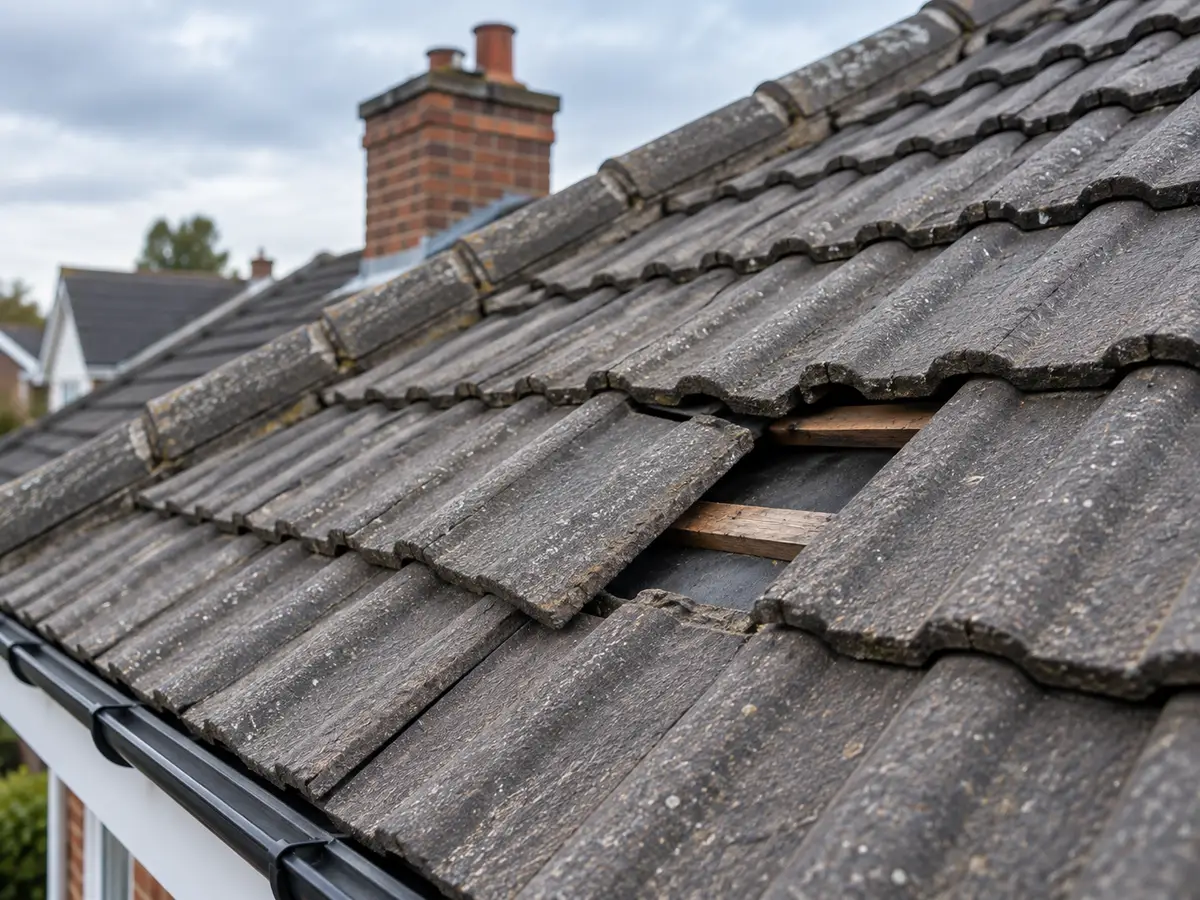
Full roof replacement tends to come up in one of three situations: repairs have become frequent enough that they're starting to add up, the damage is spread across a large area rather than one fixable section, or the roof has simply reached the end of its practical working life for its material. None of these is a hard rule — see how long a roof typically lasts and our repair cost guide for more on where that line tends to sit.
It's worth saying plainly that a full replacement is a significant undertaking — both in cost and disruption — compared with almost any repair, so it's not a decision to rush into on the basis of a single data point. A proper assessment, ideally from someone without a direct financial interest in which outcome you choose, is worth the modest extra time it takes before committing.
It's also worth noting that replacement doesn't always mean the entire roof. Some properties only need one section — a particular slope, an extension roof, a section that's structurally distinct from the rest — replaced, while the remainder is still performing well. This is worth raising explicitly when you describe your situation, rather than assuming a full property re-roof is the only option.
Whichever scale of project you're facing, the underlying process described in this guide — assessment, material choice, planning considerations, the work itself, and aftercare — applies proportionally. A partial re-roof simply moves through the same stages on a smaller footprint, typically in less time and at lower cost than a full property replacement. It's still worth working through each stage properly rather than treating a smaller project as informal, since the same detailing and workmanship considerations apply regardless of scale.
What's generally involved
- Assessment of the existing roof structure, not just the covering — the timber underneath needs to be sound before anything new goes on top of it.
- Discussion of material options, which can vary meaningfully in appearance, weight, and performance — heavier materials like natural slate sometimes require structural checks on older properties.
- Consideration of any planning rules that might apply, particularly in conservation areas or on listed buildings.
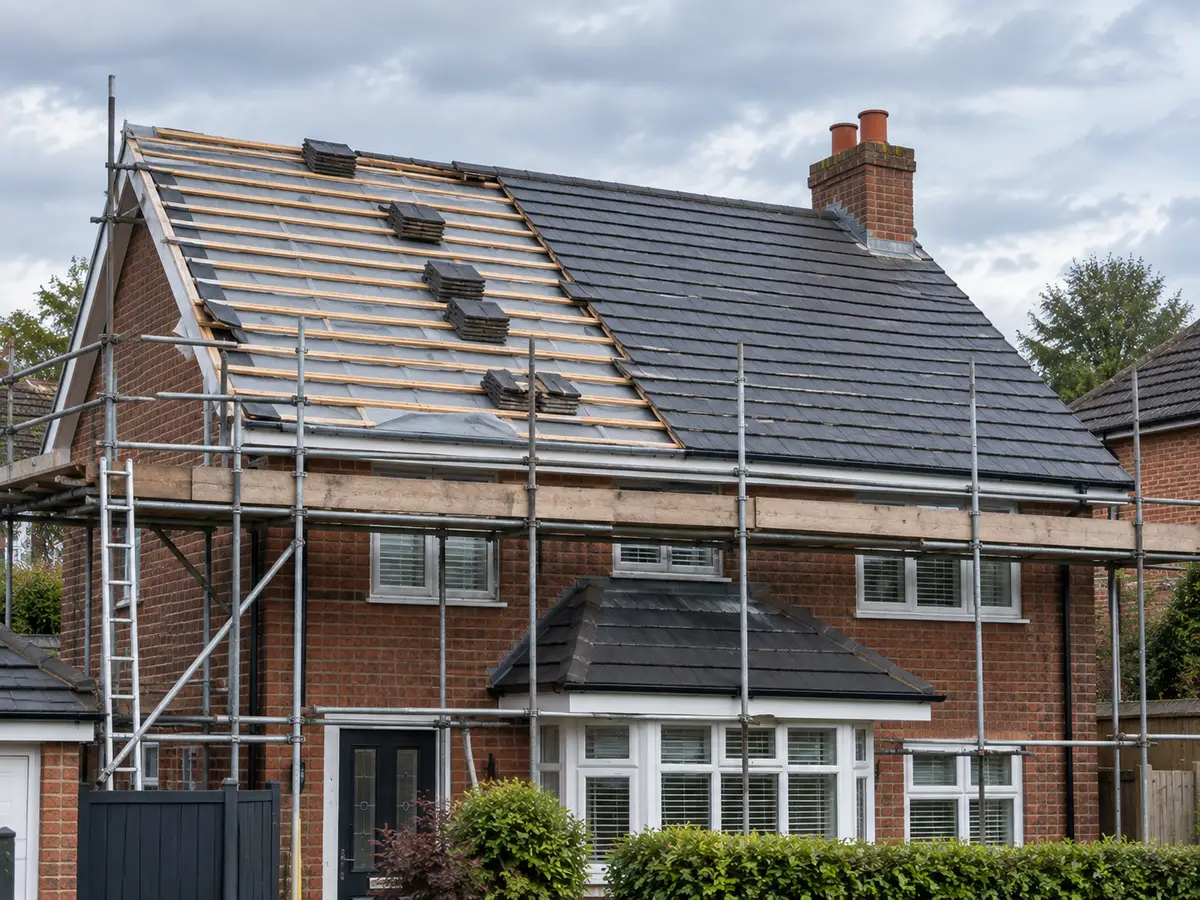
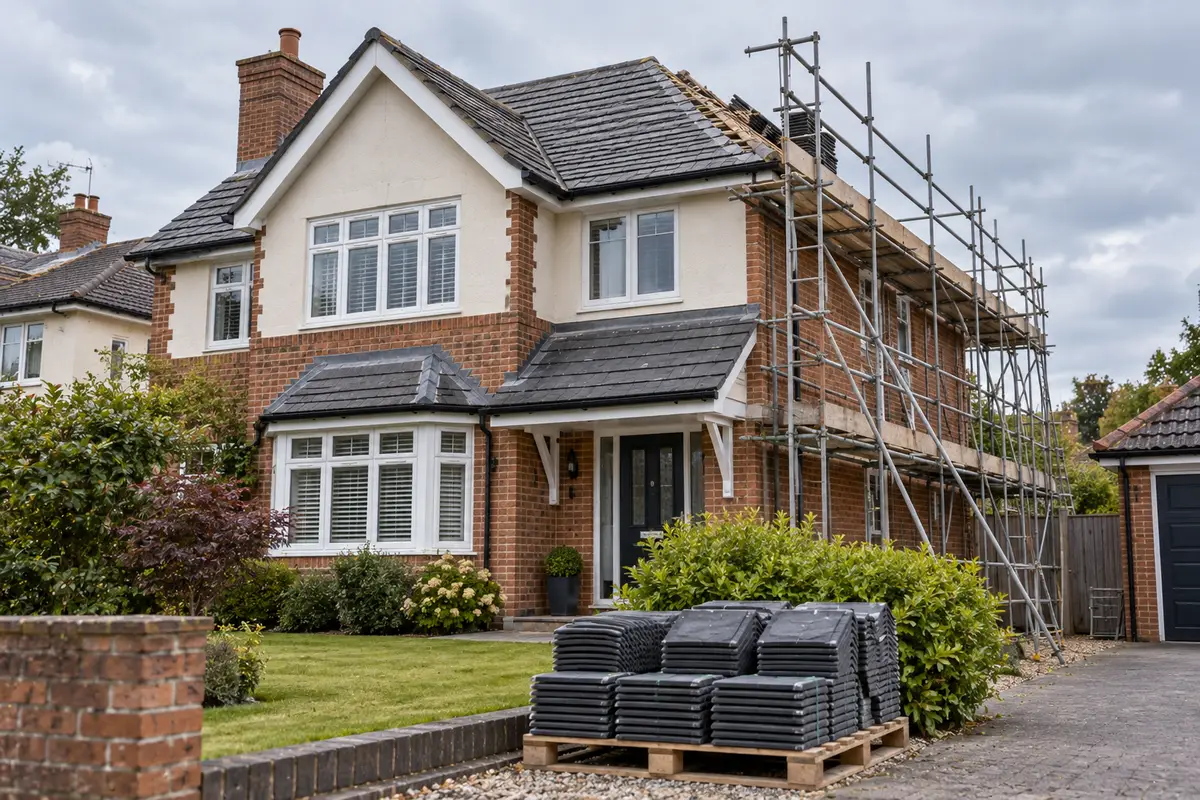
- Scaffolding erected around the property, both for safe access and to protect anything falling during strip-out.
- Removal (stripping) of the existing covering, felt/membrane and often battens.
- Any necessary structural timber repairs, identified once the old covering is off and the structure is visible.
- Installation of new underlay/membrane, battens, and the chosen covering.
- Finishing details — ridge, ropes, flashing, and guttering reinstatement.
- Final inspection and clearance of waste materials.
A general project timeline
Typical stages for a domestic re-roof
| Stage | Typical duration | What happens |
|---|---|---|
| Scaffolding erected | 1 day | Access scaffolding put up around the affected roof area |
| Strip-out | 1–2 days | Old covering, felt and often battens removed |
| Structural check & repairs | 0–3 days | Timber inspected; any rot or damage addressed — duration depends entirely on what's found |
| New underlay, battens & covering | 2–5 days | The bulk of the visible work, depending on roof size and material |
| Detailing & finishing | 1–2 days | Ridge, flashing, guttering reinstatement |
| Scaffolding down & final check | 1 day | Site cleared, waste removed, final inspection |
A straightforward semi-detached re-roof commonly totals somewhere around one to two weeks start to finish; larger or more complex roofs, or ones where structural repairs are needed, can take longer.
Choosing a replacement material
For a like-for-like replacement, this is often a simple decision — you're matching what's already there. Where it becomes a genuine choice is when you're open to changing material, whether for cost, appearance, weight, or longevity reasons.
- Matching the existing material keeps the property's appearance consistent and avoids planning complications in conservation areas, but may cost more than a modern equivalent if the original material (such as natural slate) is now a premium option.
- Switching to a more modern equivalent — concrete tile in place of ageing clay tile, for instance — can reduce cost and sometimes weight, but changes the property's appearance and may not be appropriate in a conservation area.
- Weight matters more than people expect. Heavier materials place more load on the roof structure, which is usually fine on a well-built modern property but can require a structural check on an older one before switching to something heavier than what's currently there.
- It's worth asking a roofing professional directly which options they'd recommend for your specific property, rather than choosing a material in isolation from how it'll perform on your particular roof structure and in your specific location.
Our roof lifespan guide covers the typical working life of each common material in more detail, which is useful context alongside cost when comparing options.
Planning permission and conservation areas
Many like-for-like roof replacements in the UK fall under permitted development and don't need planning permission, but this isn't universal. Conservation areas, listed buildings, and some specific local authority restrictions can all change that — and even where permission isn't formally required, conservation areas sometimes have rules about matching materials or appearance. It's worth a quick check with your local council before committing to a material change, particularly if you're considering a different covering to what's currently on the roof.
Our free planning permission checker walks through the same general questions — listed status, conservation area, and what you're actually changing — for a quick rough read before you contact the council.
Worth considering while the roof is stripped back
A full re-roof is a natural moment to consider a couple of related improvements, simply because access that's normally difficult and expensive becomes straightforward while the covering is already off.
- Loft insulation — topping up or upgrading insulation is often significantly easier and cheaper to arrange alongside a re-roof than as a separate later project.
- Loft ventilation improvements — addressing any condensation risk properly at this stage, rather than retrofitting later, tends to be both cheaper and more effective.
- Additional roof lights or vents — if you've ever considered adding a roof light to a loft space, this is typically the most cost-effective time to do it.
- Solar panel preparation — even if you're not installing panels immediately, some homeowners ask for suitable mounting provisions to be considered during a re-roof to simplify a future installation.
None of this is essential, and a straightforward like-for-like replacement is a perfectly reasonable choice — but it's worth at least considering while you have a roofing professional's attention, rather than only thinking about it once the scaffolding has already come down.
Questions worth asking before you commit
- What's included in the quoted price, and what isn't — scaffolding, waste disposal, and guttering work are common items that sometimes sit outside the headline figure.
- How long the project is genuinely expected to take, including any weather contingency.
- What happens if structural timber damage is found once the old covering is off — how it would be priced and agreed before extra work proceeds.
- What warranty or guarantee applies to the materials and the workmanship, and for how long.
- How access, parking and skip placement will be managed during the project.
- Whether the roofing professional carries appropriate insurance for work of this scale — a reasonable question to ask directly.
Choosing who does the work
For a project of this scale, it's worth taking slightly more care over who you choose than you might for a small repair. A few practical checks are reasonable to make before committing: asking to see examples of previous, similar work; checking they're comfortable providing references from recent customers; confirming they carry appropriate insurance for a job of this size; and being clear, in writing, about exactly what's included in the price.
None of this needs to feel adversarial — most roofing professionals are entirely used to being asked these questions for a project of this size, and a straightforward, confident answer to each of them is itself a reasonably good sign.
It's also reasonable to trust your own read of the situation alongside the practical checks. How clearly someone answers your questions, how organised their communication is in the run-up to the project, and whether they seem genuinely willing to explain their reasoning rather than simply asserting it — none of these are formal credentials, but they're often a reasonably good indicator of how the working relationship will go during a multi-week project.
It's worth remembering, too, that this whole process is a two-way conversation rather than a one-sided interview. A good roofing professional will usually have their own questions for you — about your priorities, your budget expectations, whether you have any specific constraints around timing or access — and a willingness to ask those questions rather than simply pricing up a generic job is itself a reasonably positive sign about how they'll approach the actual work.
Budgeting for the unexpected
Because structural timber isn't visible until the old covering is stripped off, it's sensible to budget with some contingency for a re-roof rather than treating the initial quote as an absolute ceiling. How much contingency is reasonable varies by property age and condition — a well-maintained newer property carries less risk of nasty surprises than a much older one that hasn't been touched in decades — but building in some flexibility, and asking your roofer directly what they typically see in similar properties, helps avoid the project stalling on cost if something does turn up.
It's also worth discussing payment structure upfront. Staged payments tied to project milestones (scaffolding up, strip-out complete, new covering on, final completion) are common for larger jobs and give both sides a clearer sense of progress against cost, rather than a single lump sum at the very end or full payment demanded upfront.
What happens to the old materials
Old roofing materials are generally removed and taken away by the roofing professional as part of the job, typically via a skip on site or direct removal. Many materials — clay and concrete tiles, slate, and scrap metal from flashing — are recyclable or reusable, and some roofers will separate genuinely reusable materials (particularly natural slate, which holds value) rather than sending everything to landfill. It's a reasonable question to ask as part of getting a quote, particularly if you have any preference about how waste is handled.
Living in the property during the work
Most domestic re-roofs don't require moving out — the work happens outside and above the property rather than inside it — but it's worth expecting noise, scaffolding around the building, and temporary disruption to things like satellite dishes or loft access for the duration. If you have a specific concern, such as a home office that needs to stay usable or a pet sensitive to noise, it's a reasonable thing to raise with the roofing professional before scheduling.
Warranty and what happens after completion
A full re-roof typically comes with two separate types of cover worth understanding: a materials warranty from the manufacturer (covering defects in the tiles, membrane or other products used) and a workmanship guarantee from the installer (covering the quality of the installation itself). These aren't always the same length, and it's worth getting the specifics — what's covered, for how long, and what would void it — in writing rather than as a verbal assurance.
- Ask for written confirmation of both the materials warranty and the workmanship guarantee, including their respective durations.
- Check whether the guarantee is transferable if you sell the property — this can be a useful selling point later.
- Ask what your own responsibilities are for maintaining the guarantee, such as periodic gutter clearing or avoiding certain modifications.
- Keep the paperwork somewhere safe alongside other property documents — it's easy to misplace and genuinely useful to have later.
Getting started
If you think you're heading towards a full replacement, the most useful first step is usually a proper assessment rather than jumping straight to material choices — it's worth reading how long a roof typically lasts and considering a roof inspection first if you haven't already had one.
Frequently Asked Questions
How long does a typical UK roof replacement take?+
A straightforward semi-detached property commonly takes around one to two weeks from scaffolding going up to coming down, though this varies with roof size, material, weather, and whether any structural repairs are needed.
Can I stay in my house during a roof replacement?+
Generally yes — the work is external. Expect noise and some disruption, particularly during the strip-out stage, but moving out isn't typically necessary for a standard domestic re-roof.
Do I need planning permission to replace my roof?+
Many like-for-like replacements don't need planning permission under permitted development rules, but conservation areas, listed buildings and some local restrictions can change this. Check with your local council if you're unsure, especially before changing materials.
What happens if rot or damage is found in the roof timbers?+
This is a fairly common discovery once the old covering is stripped off, since the timber isn't visible beforehand. A reputable roofing professional should pause to explain what they've found and agree a price for any additional work before proceeding.
Can I change the roofing material when I replace my roof?+
Often yes, subject to planning considerations in conservation areas and structural suitability — heavier materials like natural slate can require checking that the existing structure can support the added weight, particularly on older properties.
What's the difference between a materials warranty and a workmanship guarantee?+
A materials warranty (from the manufacturer) covers defects in the products used. A workmanship guarantee (from the installer) covers the quality of the installation itself. Both are worth having in writing, and they don't always run for the same length of time.
How much contingency should I budget above the quoted price?+
There's no universal figure — it depends on the property's age and condition — but it's sensible to have some flexibility rather than treating the initial quote as an absolute ceiling, particularly on older properties where structural timber condition is unknown until the roof is stripped.
Is it worth upgrading loft insulation while the roof is being replaced?+
Many homeowners find it's a convenient and often more cost-effective time to do this, since access that's normally difficult becomes straightforward while the roof covering is off. It's worth raising with your roofing professional if you're interested.
How do I know if a roofing professional is suitable for a full replacement, not just repairs?+
Asking about experience with projects of a similar scale, requesting examples of recent similar work, and confirming appropriate insurance cover are all reasonable steps before committing to a large project.
Will a roof replacement disrupt my neighbours?+
There's typically some shared impact — scaffolding footprint, delivery access, noise — particularly on terraced or semi-detached properties. It's considerate to give neighbours advance notice, and many roofing professionals will factor shared-access logistics into their planning.
Should I be at home during the re-roofing work?+
It's not strictly necessary once the project is underway, though being available for key moments — such as when structural issues are found, if any — is useful. Many homeowners are out at work during the day while the work happens.
What's the best time of year to schedule a roof replacement?+
Late spring through early autumn tends to offer more predictable weather for a project of this scale, though roofing work happens year-round in the UK. If timing is flexible, it's worth discussing seasonal considerations with your roofing professional.