Signs Your Roof May Need Repair
By RoofEnquiry Editorial · Updated 2 February 2026 · 10 min read
Quick answer
- Most early warning signs are visible from inside the house — ceiling staining, a musty smell, or daylight in the loft.
- From outside, look for missing or slipped tiles, sagging roofline, and debris collecting in gutters — all from ground level only.
- Not every sign means an emergency, but most are worth acting on before the next spell of bad weather.
- If you're not sure how urgent something is, a proper roof inspection is a low-cost way to get a clear answer.
Why the roof is the easiest part of the house to neglect
Most of a house gets looked at constantly, just by living in it. The roof doesn't — it's the one major structural element most homeowners never actually see up close, which means early problems tend to announce themselves indirectly, through symptoms inside the house, long before anyone spots the actual cause. That's the reason this list is split the way it is: what you can notice without ever leaving the ground or climbing anything.
Signs to look for inside the property
| Sign | What it can indicate | How urgent |
|---|---|---|
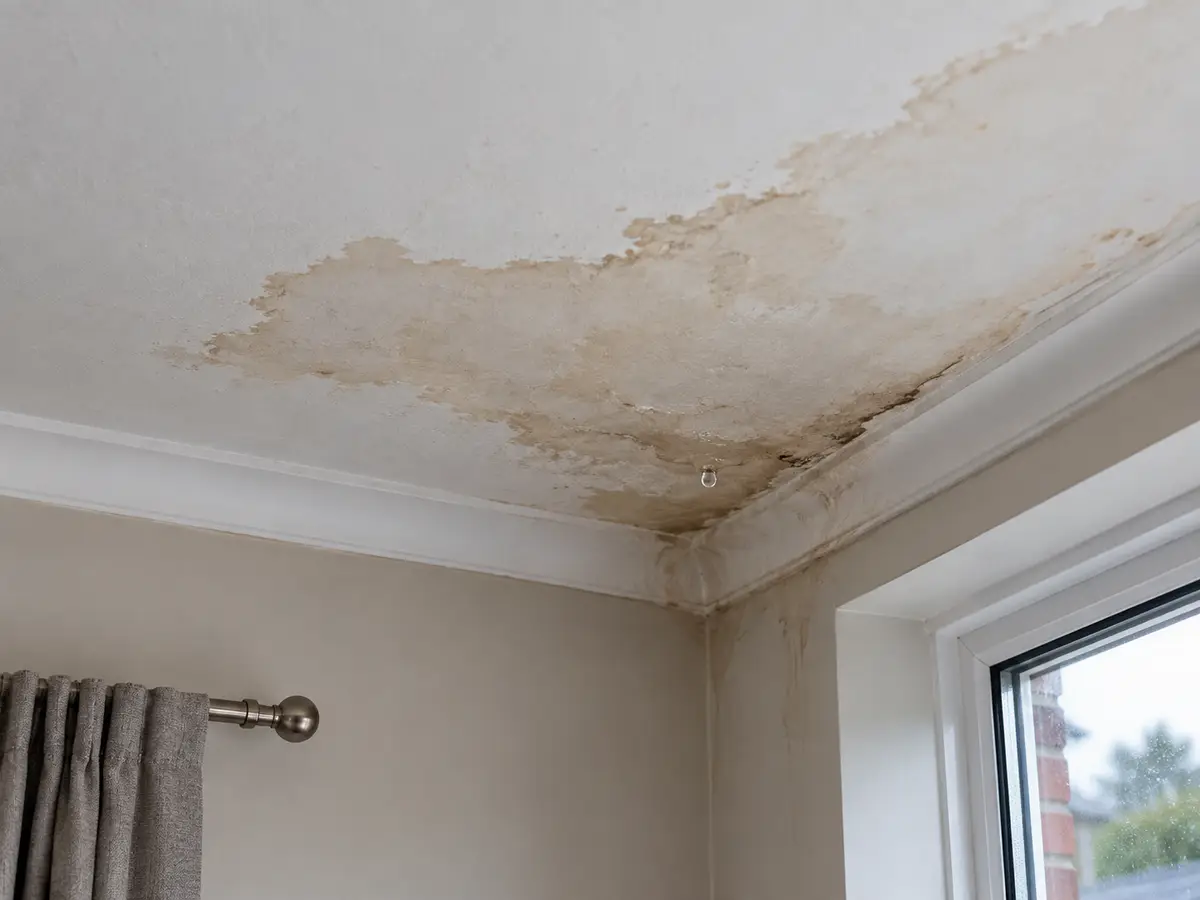
| Damp or discoloured ceiling patches | Water ingress from above, often from a slipped tile or failed flashing | Moderate–high, especially if growing |
| Musty smell in the loft or top-floor rooms | Trapped moisture, sometimes condensation rather than a leak | Moderate — worth checking |
| Daylight visible through the roof from the loft | Gaps in the covering or underlay | High — direct route for water ingress |
| Peeling paint or bulging plaster near ceilings | Longer-term or repeated water ingress | High — often means it's been happening a while |
| Sagging ceiling in a specific spot | Saturated plasterboard from sustained water ingress | High — treat as urgent |
It's worth understanding why indoor signs often appear before you'd expect. Water rarely announces itself immediately — a small gap in a roof covering can let moisture into the loft space for weeks or months before it saturates through insulation, timber and plasterboard enough to show as a visible stain on a ceiling below. By the time you can see it from the room underneath, the underlying issue has usually been present for a while already, which is one reason a musty smell or a subtle patch is worth acting on rather than waiting for it to become more obvious.
It's also worth checking rooms you don't use every day — a spare room, box room, or landing cupboard under a sloped ceiling can develop a problem that goes unnoticed for longer simply because nobody's in there often enough to spot it early.
If any of this sounds familiar and there's active water coming through right now, it's worth reading what to do if your roof is leaking for the immediate steps, rather than just the diagnosis.
Signs to look for from outside (ground level only)
A few practical tips make this more effective. Walk around the whole property rather than looking from a single spot, since problems often only show from certain angles. Check on a dry, reasonably bright day where possible — shadows and wet surfaces both make small details harder to spot. And where you can, compare against a previous check or photo, since a subtle change is often easier to notice than trying to assess everything from scratch each time.
| Sign | What it can indicate | How urgent |
|---|---|---|
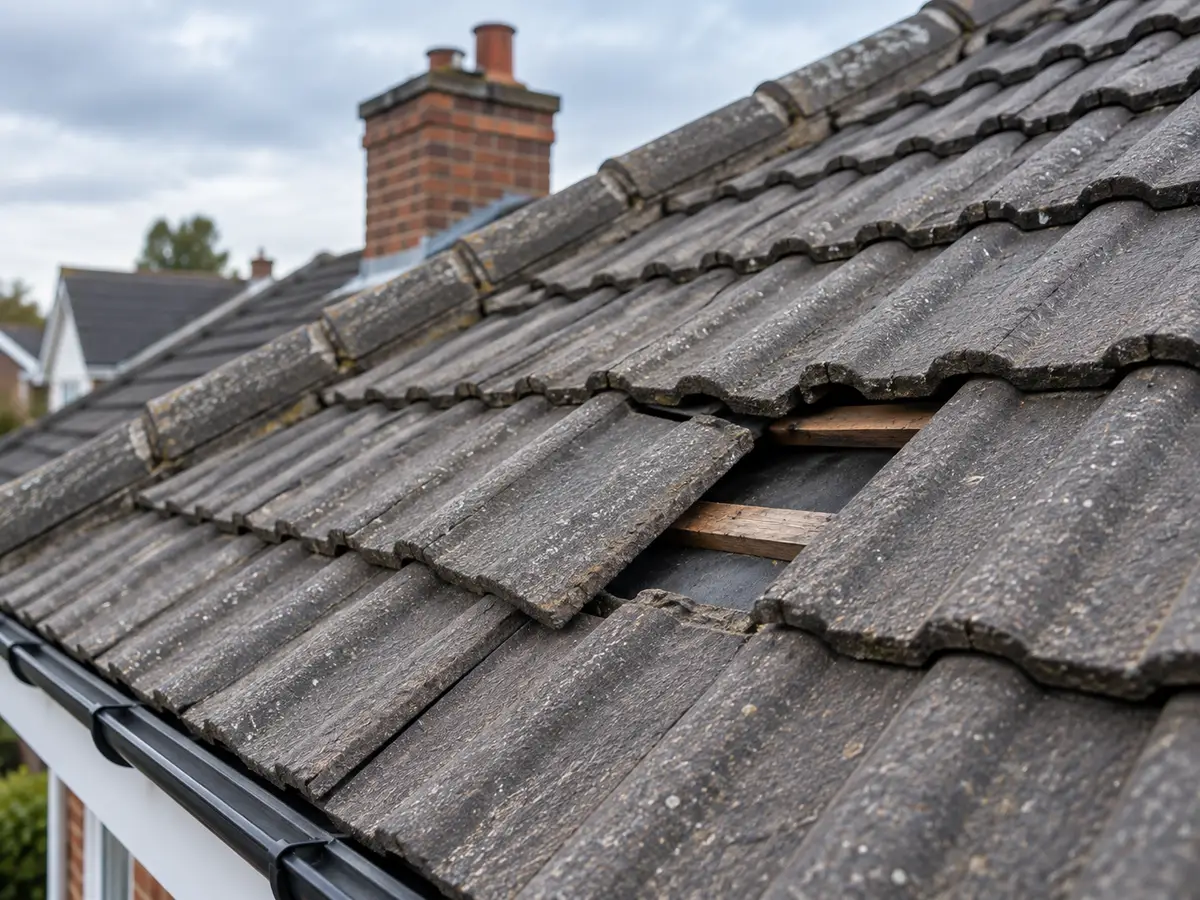
| Missing, cracked or slipped tiles/slates | Wear, age, or storm damage | Moderate–high depending on extent |
| Sagging sections of roofline | Potential structural timber issues | High — worth prompt assessment |
| Debris (tile fragments, mortar) in gutters or on the ground | Ongoing deterioration of the covering | Moderate |
| Moss or vegetation build-up on the roof | Trapped moisture, accelerated wear over time | Low–moderate |
| Cracked or crumbling mortar around the chimney | Repointing likely needed | Moderate |
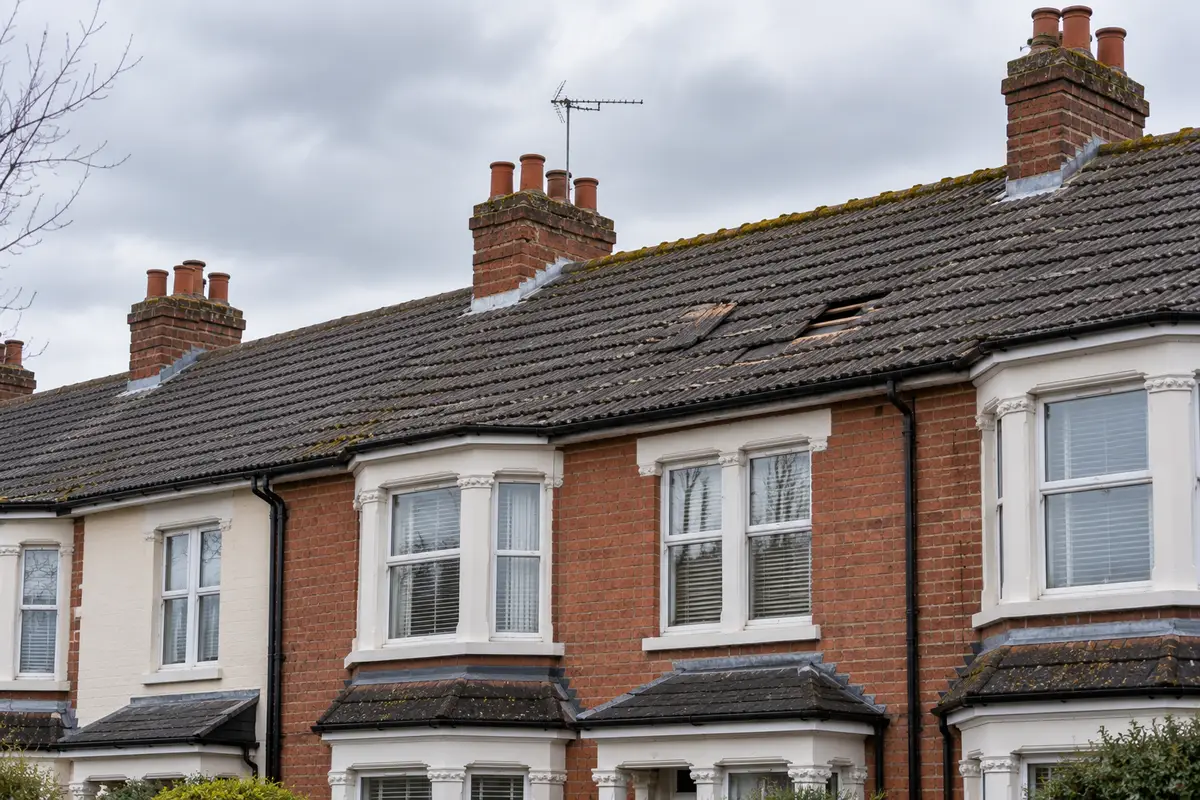
| Visible gaps or dark patches in the roofline pattern | Missing tiles or slipped coverage | Moderate–high |
| Staining on external walls below roof level | Water tracking down from a leak or guttering fault | Moderate |
A few of these are easy to miss simply because of where they are. Chimney stacks and valleys (the internal angles where two roof slopes meet) take more weather than the main slopes of a roof, so they're often the first place small problems appear — worth a specific look, not just a general glance at the roofline.
A simple severity guide
- Act promptly (days, not weeks): active leaks, sagging rooflines or ceilings, daylight visible through the roof, and anything following a recent storm.
- Worth booking in soon: missing tiles, cracked chimney mortar, musty loft smells, and staining that's new or spreading.
- Keep an eye on it: moss build-up, minor gutter debris, and cosmetic ageing that isn't affecting the roof's ability to keep water out.
A few common misconceptions worth clearing up
- "If there's no visible leak inside, the roof must be fine." Not necessarily — plenty of early-stage problems (worn coverings, early flashing wear, minor storm damage) exist for a while before they progress to an actual leak. Absence of a leak isn't the same as a clean bill of health.
- "A roof only needs attention once it's actually failing." Catching problems earlier is almost always cheaper and less disruptive than waiting until they're serious, which is really the whole point of this page.
- "Moss is just cosmetic." Light moss usually is, but heavier build-up traps moisture against the covering over an extended period, which can accelerate wear underneath it even though the moss itself isn't the direct cause of failure.
- "New-build roofs don't need checking." They're statistically less likely to have problems early on, but installation defects, while uncommon, do happen on any property regardless of age — an occasional check costs nothing.
- "If my neighbour's roof (same age, same street) is fine, mine probably is too." Not necessarily — orientation, tree cover, original installation and maintenance history can all differ between otherwise similar properties.
These misconceptions are worth clearing up because they tend to push people in one of two unhelpful directions: either assuming everything's fine until there's an obvious, dramatic problem, or the opposite, panicking over something genuinely minor. Neither serves you particularly well. The more useful mindset is simply paying steady, ongoing attention, and treating this list as a prompt to check rather than a verdict on its own.
One more worth adding to the list: "getting a second opinion is a waste of time and money." It rarely is. If a quote or an assessment doesn't sit right with you, or simply doesn't match what you understood the problem to be, asking a second professional to take a look costs little beyond a bit of time, and can be genuinely reassuring either way — whether it confirms the first opinion or turns up something different.
Does it matter what kind of property you have?
The signs themselves are broadly the same across property types, but where you're likely to spot them first can differ a little.
| Property type | Worth paying particular attention to |
|---|---|
| Terraced / end-of-terrace | Valley gutters between adjoining roofs, which can be harder to see clearly and are a common source of shared-roof leaks |
| Semi-detached | The shared party wall side, where roofs meet, and any chimney stack shared with the neighbouring property |
| Detached | A larger total roof area generally means more to keep an eye on — a slow, methodical walk around the property covers more ground than a single glance |
| Bungalow | Lower roofline makes ground-level checks easier and more detailed than on a two-storey property |
| Flat / apartment | Usually limited to what's visible from your own windows; shared roof areas are generally the building management's responsibility to monitor |
Signs specific to flat roofs
Flat roofs — common on extensions, garages and some full properties — have their own set of warning signs that don't fit neatly into the pitched-roof list above: water sitting on the surface for more than about 48 hours after rain, visible blistering or cracking in the covering, and lifted edges or seams. These are covered in more detail in our flat roof problems guide, which is worth a read if that's the kind of roof you have.
How the roof's age changes what you're watching for
A newer roof developing one of these signs is more likely to point to a specific, isolated fault — a single damaged tile, a one-off installation issue — than to general wear. On an older roof, particularly one approaching or past its material's typical lifespan, the same sign is more likely to be one of several early indicators that the whole covering is nearing the end of its working life, rather than an isolated problem. Neither situation is something to guess at — understanding typical roof lifespans by material can help you judge which situation is more likely for your own roof, but only a proper inspection tells you for certain.
Three realistic scenarios
Sometimes it's easier to judge urgency against a comparable example than against an abstract list. Here are three fairly typical situations and how they'd generally be read.
- A homeowner notices a single tile has slipped after a windy week, visible from the street, with no signs of damp inside. This is a fairly routine repair — worth booking in reasonably soon before weather worsens the exposed area, but not a middle-of-the-night emergency.
- A ceiling in a top-floor bedroom develops a growing damp patch over a fortnight, with a faint musty smell in the loft above it. This combination — active, worsening, with a related smell — points to a genuine, ongoing leak worth treating as a priority rather than monitoring further.
- A homeowner spots light moss on a north-facing roof slope and a little debris in the gutter during an autumn check, with nothing else unusual. This is worth a note and a bit of gutter clearing, but isn't urgent on its own — exactly the kind of thing a regular seasonal check is designed to catch early, well before it becomes anything more serious.
- A landlord managing a rented property receives a tenant report of a musty smell in an upstairs bedroom, with no visible staining yet. Worth investigating reasonably promptly, since a smell without visible staining can still indicate early-stage trapped moisture — catching it at this stage, before it progresses to visible damage, is exactly the outcome worth aiming for.
After a storm
High winds change the calculation. A quick ground-level check after any significant storm is sensible even if nothing seems obviously wrong — displaced tiles aren't always visible from every angle, and storm damage can also affect guttering, flashing and chimney stacks in ways that aren't immediately obvious from inside the house.
What a professional checks that you simply can't from the ground
It's worth being honest about the limits of a ground-level check, useful as it is. A roofing professional working at height can examine the actual condition of individual tiles and fixings, check flashing and pointing up close, assess the underlay and battens from inside the loft in a way that goes beyond a quick torch check, and spot early signs of movement or wear that simply aren't visible from below. This page is genuinely useful for catching obvious problems early and knowing when something's worth flagging — it isn't a substitute for that closer look.
That gap between what you can see and what a professional can see is exactly why this page frames itself as a spotting guide rather than a diagnosis tool. Two different roofs can show an identical ground-level sign — a patch of moss, a faint ceiling stain — for entirely different underlying reasons, and telling those reasons apart is precisely the kind of judgement call that comes from close-up experience rather than a checklist.
When to bring in a professional
This page is about spotting early warning signs, not replacing a proper assessment. If you've noticed one or more of the signs above, or simply want peace of mind before winter, a roofing professional can carry out a full inspection and tell you what — if anything — actually needs doing, and roughly how urgent it is.
As a general rule: if what you've noticed is on the "act promptly" list above, it's worth describing the specific problem via a roof repair enquiry. If it's more of a general "is this okay" question without an obvious specific fault, a roof inspection is usually the more appropriate starting point.
Frequently Asked Questions
How often should I check my roof for these signs?+
A couple of times a year from the ground is a reasonable habit for most homes, plus a quick check after any significant storm. See our {{guide:roof-inspection-checklist-for-homeowners|roof inspection checklist}} for a fuller routine.
Is moss on the roof always a problem?+
Not necessarily on its own, but heavy moss build-up can trap moisture against the roof covering over time, which may accelerate wear. It's worth monitoring rather than ignoring completely.
I can see a damp patch but it's not raining — could it still be the roof?+
Yes — condensation from poor loft ventilation can cause damp patches unrelated to current weather, as can a slow leak that only shows itself after it rains, with the damp lingering afterwards. Either way, it's worth having looked at.
Can I inspect my own roof with binoculars instead of a ladder?+
Yes, viewing the roof from ground level with binoculars is a safe way to get a slightly closer look at the roofline without climbing anything.
Should I worry about a single missing tile, or is that normal wear?+
A single missing tile is worth fixing promptly, since it's a direct gap for water to get through, but it doesn't necessarily mean the wider roof is failing — it's often an isolated fix rather than a sign of a bigger problem, particularly on an otherwise sound roof.
My neighbour's roof looks worse than mine but we're the same age property — why?+
Roofs on identical-age properties can age at different rates due to differences in original installation quality, aspect (which sides face prevailing wind and rain), loft ventilation, and maintenance history — age alone doesn't determine condition.
Is it worth checking the roof before buying a property?+
Yes — a roof inspection as part of, or alongside, a property purchase survey is a sensible step, since roof condition can be a significant factor in future costs and isn't always obvious from a standard viewing.
Can weather forecasts help me time my checks better?+
It's a reasonable idea — checking before an expected storm (to note baseline condition) and again afterwards (to spot any change) can be more informative than a single check at a random time.
What's the single most important sign not to ignore?+
If there's a genuine, forced choice, active water ingress inside the property is the one to prioritise above all others — everything else on this list is worth acting on, but an active leak has the clearest potential to cause ongoing damage the longer it continues.
Are these signs different for a roof with solar panels installed?+
The signs themselves are the same, though solar panels can make some areas of the roof harder to see clearly from the ground. It's worth checking visible edges and unobstructed sections a little more carefully, and mentioning the panels if you do submit an enquiry, since they can affect access for any repair work.
Should I be more concerned about signs on a roof I've just bought?+
Not necessarily more concerned, but it's worth establishing a baseline early — a first thorough check shortly after moving in, ideally alongside any survey information, gives you something to compare future checks against.