Chimney Repair Explained: Repointing, Flashing and Common Problems
By RoofEnquiry Editorial · Updated 27 March 2026 · 11 min read
Quick answer
- Chimneys are exposed to more weather than the rest of the roof, so problems here tend to appear earlier than elsewhere.
- Repointing (renewing the mortar between bricks) and flashing failure (the seal where the chimney meets the roof) are the two most common issues by far.
- A leaning, cracked or visibly unstable stack is the one chimney problem that's worth treating as urgent rather than routine.
- An unused, disused chimney still needs occasional maintenance — 'we never use it' doesn't mean it can be ignored indefinitely.
Why chimneys need attention before the rest of the roof
A chimney stack sits higher than the surrounding roofline and is exposed to wind, rain and temperature swings from every direction, not just from above like the main roof slopes. That extra exposure is exactly why chimney problems are often the first sign of wear on an otherwise sound roof — the chimney has simply been taking more punishment for longer.
It helps to think of a chimney as having two largely separate jobs, each with its own way of failing. The brickwork and mortar (the stack itself) is a structural, weatherproofing job — keeping the stack standing and keeping water out of the masonry. The flashing — a strip of material, usually lead, sealing the join where the chimney meets the roof covering — is a completely different job, sealing a junction between two different building elements that expand, contract and age at different rates. Most chimney problems trace back to one of these two systems, rarely both at once.
Repointing: the most common chimney job
Repointing means raking out old, deteriorated mortar from between the bricks and replacing it with fresh mortar. It's routine maintenance rather than a sign of a badly built chimney — mortar is designed to wear faster than the brick around it, partly so that it's the mortar that needs periodic renewal rather than the brickwork itself.
- Mortar that looks crumbly, has visible gaps, or comes away easily when gently touched.
- Small mortar fragments or dust collecting on the roof below the stack, or in the gutter.
- A stack that looks noticeably more weathered or lighter in colour than the brickwork lower down the property, which gets less direct weather exposure.
- Visible dark staining or damp patches on a chimney breast wall inside the property, which can indicate water getting into the stack through failed pointing.
Repointing itself is usually a fairly contained job — raking out the old mortar to a reasonable depth, then repacking with new mortar matched roughly to the original in both mix and colour where that matters for appearance. On a chimney in generally good condition, it's often the only work needed for years at a time once done properly.
Flashing failure: the other common cause
Flashing is the metal strip — almost always lead in the UK — dressed into the join between the chimney and the surrounding roof covering. It's a genuinely clever detail: lead is soft enough to be shaped by hand around the specific angles of a chimney, and flexible enough to accommodate a small amount of ongoing movement between the brick stack and the roof structure without cracking, the way a rigid material would.
That flexibility is also, eventually, its weak point. Lead flashing can lift, curl, or tear away from the brickwork over years of weather and movement, and once there's a gap, it's a direct route for water to get into the roof structure right at one of the most vulnerable junctions on the whole roof. This is a big part of why flashing failure is such a common cause of chimney-related leaks specifically, rather than problems with the stack itself.
Signs of flashing trouble
| Sign | What it usually means |
|---|---|
| Visible gap or lifted edge where flashing meets the brick | Flashing has pulled away, likely already letting some water through |
| Curled or torn section of the flashing itself | Material fatigue, sometimes accelerated by a specific storm |
| Leak concentrated specifically near the chimney breast, more than elsewhere in the room | Classic sign of flashing failure rather than a general roof covering issue |
| Green or white staining on the lead itself | Normal weathering (patina) — not necessarily a fault on its own |
That last row is worth dwelling on, because it trips people up. Lead naturally develops a grey-white or slightly green patina as it weathers, and that alone doesn't mean it's failing — it's a completely normal part of how lead ages, and it's actually part of what protects the metal underneath. What actually matters is whether the flashing is still physically intact and properly sealed against the brickwork, not what colour it's turned.
A leaning or visibly unstable stack
This is the one chimney problem worth treating differently from the rest. A stack that looks like it's leaning, has a visible crack running through several courses of brick, or has bricks that seem to be separating from the main structure, is a genuinely more serious situation than repointing or flashing — it's potentially a structural issue, not just a weatherproofing one.
It's worth saying that outright structural failure of a chimney is uncommon — most chimney problems genuinely are routine repointing or flashing work. But because the consequences of ignoring a real structural issue are more serious than with most other roofing problems, this is the one category where "it's probably fine, I'll keep an eye on it" is the wrong instinct.
Pots, caps and capping
A few smaller chimney components cause their own specific, usually minor, problems worth knowing about separately from the stack and flashing.
- Chimney pots — the terracotta or clay fittings on top of the stack — can crack, chip, or come loose from their mortar bedding over time, sometimes visibly at an angle when this happens.
- A cracked or missing pot on a chimney still in use can affect how well it draws smoke and, in some cases, let more water into the flue than it's designed for.
- Chimney caps or cowls (added covers, often mesh or metal) are sometimes fitted specifically to keep rain and birds out of an unused flue, and can themselves work loose or need resecuring over time.
- None of these are usually urgent on their own, but a visibly displaced pot is worth mentioning alongside anything else you've noticed, since it's a straightforward thing for a roofing professional to check and resecure at the same time as other chimney work.
What about a chimney you never actually use?
A disused chimney — one with a capped or blocked-off fireplace, or simply never connected to anything — still needs the same basic weatherproofing maintenance as one in active use. The stack and its flashing don't know whether there's a fire underneath; they're still exposed to exactly the same weather either way.
It's a genuinely common misconception that an unused chimney can just be left alone indefinitely. In practice, a neglected disused stack can develop exactly the same repointing and flashing problems as an actively used one, and because nobody's checking on it (there's no fire to prompt an annual sweep or inspection), problems can go unnoticed for longer before they show up as a leak or a fall of debris.
What the two repairs actually look like on the roof
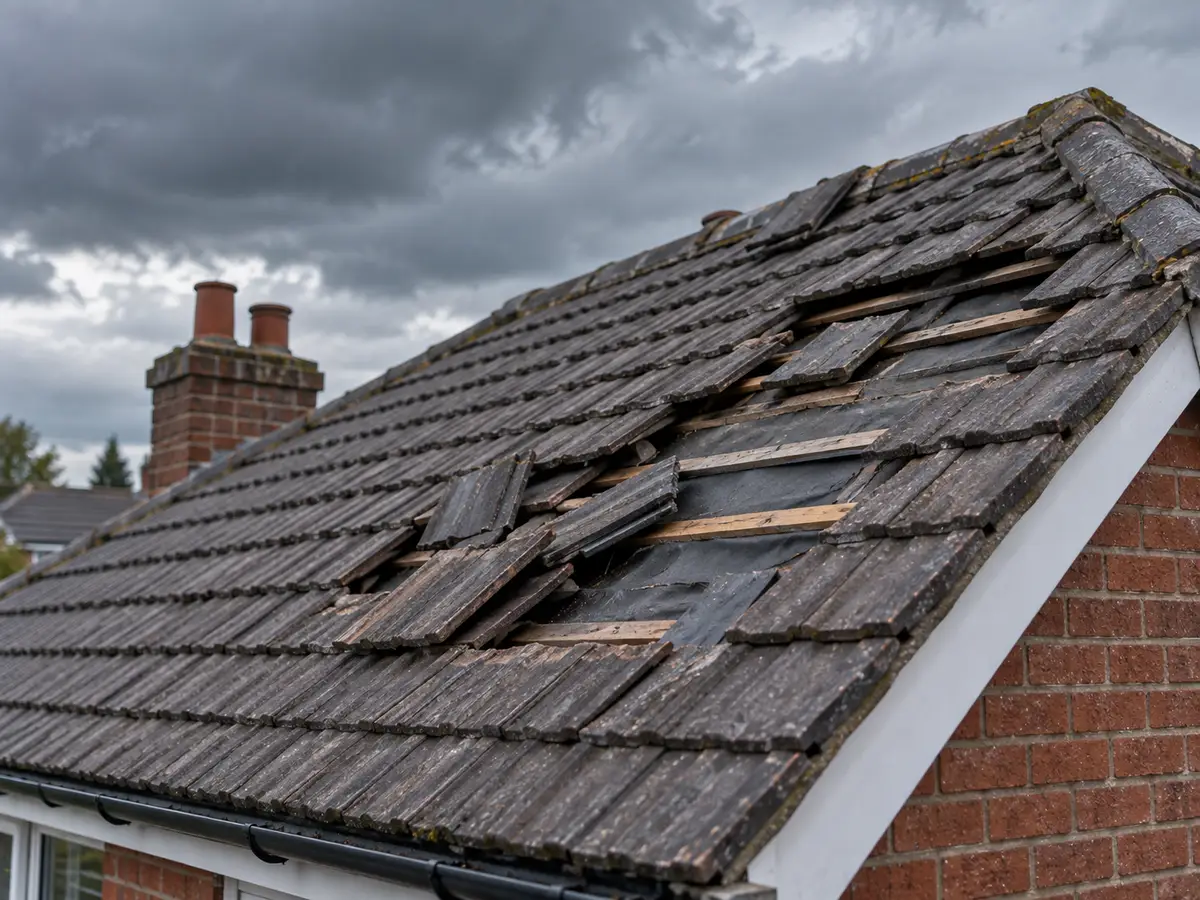
It's easier to judge what you're looking at, and roughly what a repair might involve, with a couple of concrete examples rather than abstract descriptions.
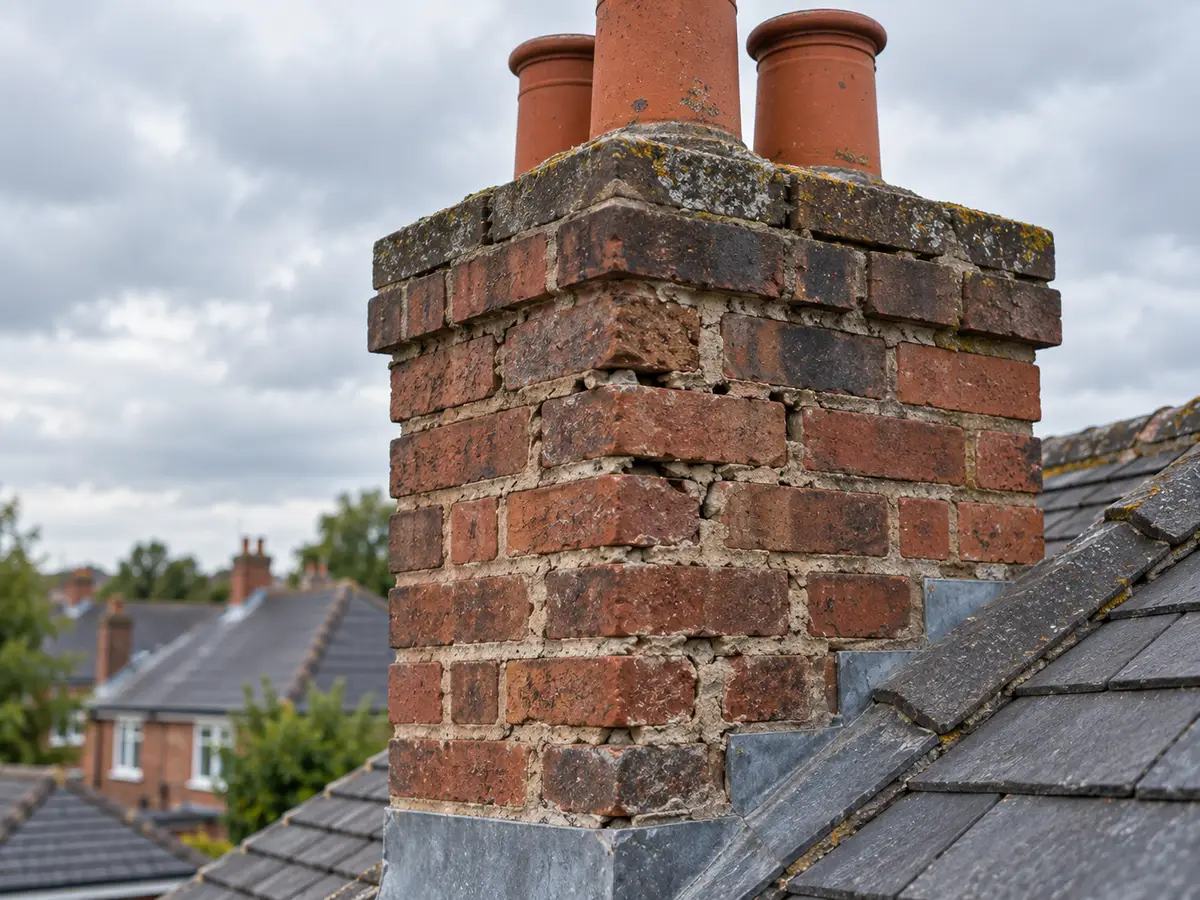
- A stack with crumbling, uneven mortar and visible gaps between courses of brick, sometimes with small fragments of loose mortar visible nearby — typically resolved by raking out and repointing the affected courses.
- Torn or lifted lead flashing at the base of the stack, where it meets the roof tiles, sometimes with visible daylight or a gap underneath — typically resolved by removing the damaged section and dressing new lead flashing into the joint.
In both cases, the "after" result looks deliberately unremarkable — neat, even mortar lines or a smooth, properly dressed flashing joint that simply looks like it's doing its job, rather than anything visually dramatic. That's actually a good sign: a chimney repair that looks unremarkable once finished is usually one that's been done properly.
Access and why chimney work often needs scaffolding
Because a chimney sits at the highest point of the roof, working on it safely often needs more than a ladder — scaffolding or a tower scaffold is common, particularly for anything beyond a very minor, quick job. This is one of the bigger factors in chimney repair cost, and it's also why it's often worth mentioning if you know you'll need other roof work done around the same time — sharing access equipment across jobs can be more efficient than arranging it twice.
Our cost guide covers general UK price ranges including chimney repointing specifically, and access is exactly the kind of factor that explains why two seemingly similar chimney jobs can end up priced quite differently.
Is it repointing, or does the whole stack need rebuilding?
Repointing addresses the mortar; rebuilding addresses the bricks themselves. As a rough guide, if the brickwork is generally sound and it's mainly the mortar that's failed, repointing is normally sufficient and considerably less involved than a rebuild. Rebuilding — taking the stack down to a sound point and reconstructing it — tends to come up when the bricks themselves are significantly eroded, cracked, or the stack shows genuine structural movement rather than just weathered mortar.
This isn't something to try to judge yourself from the ground with any precision — the difference between "needs repointing" and "needs partial rebuilding" often only becomes clear once someone's actually up there and can assess the brick condition close up, not just the mortar.
Why chimney problems often show up after winter
UK chimney problems have a noticeable seasonal pattern. Water that's got into small gaps or cracks in mortar over autumn can freeze during a cold snap, and freezing water expands — widening existing cracks and sometimes creating new ones in the process. This freeze-thaw cycling, repeated over a winter, is one of the main reasons chimney mortar that looked borderline in October can look noticeably worse by March, without anything dramatic having happened in between.
The same pattern applies to lead flashing, to a lesser extent — a small lift or gap that wasn't quite letting water through in summer can worsen once winter wind and rain start driving water into it more forcefully and more often. This is part of why an autumn check, before the worst of the winter weather arrives, is a genuinely useful habit rather than just a general suggestion — it's aimed at catching exactly this kind of problem while it's still small.
A quick check you can safely do from the ground
As with the rest of the roof, a chimney can be checked reasonably well from ground level without climbing anything. Binoculars help pick out detail that's hard to see with the naked eye from a distance, and a slow walk around the property gives a few different viewing angles rather than relying on a single spot.
- Look at the mortar lines between bricks on the stack — do they look even and intact, or crumbly and uneven with visible gaps?
- Check the stack's overall alignment against a vertical reference, like a nearby drainpipe or window frame — does it look straight, or subtly off?
- Look at the base of the stack where it meets the roof for any visible lifted or gapped flashing.
- Check the pots are sitting securely and aren't visibly cracked, chipped, or leaning.
- Note whether there's any staining on the chimney breast wall inside the property, which is worth checking at the same time even though it's a separate, indoor observation.
None of this replaces a close-up professional assessment, particularly for judging mortar depth or brick condition accurately, but it's enough to know whether something's worth flagging — which is really the point of a ground-level check anywhere on the roof, not just the chimney.
Getting a chimney problem looked at
As with most roofing problems, the details that help most are what you've actually observed — whereabouts on the stack, whether there's any damp or staining inside the property near the chimney breast, and roughly how long it's been visible. Our guide on what information to give a roofer covers this in more general detail, and the same principles apply directly to chimney problems.
If you're not sure whether what you've noticed is worth acting on now or just keeping an eye on, our general signs of roof repair guide has a severity guide that applies to chimney issues as much as the rest of the roof — with the one exception, covered above, that a visibly leaning or structurally unstable stack should always be treated as a priority regardless of how it compares to other, more routine signs.
Frequently Asked Questions
How do I know if it's repointing or a flashing problem?+
Repointing issues show as crumbling or missing mortar between the bricks themselves. Flashing issues show at the join where the chimney meets the roof covering — a gap, lifted edge, or torn section of the metal strip sealing that junction. A leak specifically near the chimney breast more often points to flashing.
Is it normal for lead flashing to look green or white?+
Yes — lead develops a natural patina as it weathers, which is a normal part of the material ageing rather than a sign of failure on its own. What matters is whether the flashing is still physically intact and sealed, not its colour.
How often does a chimney need repointing?+
This varies significantly with exposure, the quality of the original mortar, and local weather conditions, but many chimneys need repointing at some point over their lifetime, since mortar is designed to wear faster than the surrounding brick.
Do I need to stop using my fireplace if the chimney needs repair?+
If there's any doubt about safety — particularly with a leaning or structurally unstable stack — it's best to stop using the fireplace or connected appliance until it's been assessed. For routine repointing or flashing issues without structural concerns, a roofing professional can advise on your specific situation.
My chimney isn't connected to anything — does it still need maintaining?+
Yes — a disused chimney is exposed to exactly the same weather as one in active use, and can develop the same repointing and flashing problems. It's worth including in a general roof check even if you never use it.
Can a chimney be removed instead of repaired?+
In some cases, yes, though this is a bigger structural project than a repair and typically involves making good the roof where the stack was, plus internal work if the chimney breast is being removed too. It's worth discussing the options with a roofing professional if this is something you're considering rather than a straightforward repair.
Why does chimney work often need scaffolding when other repairs don't?+
A chimney sits at the highest point of the roof, so safe access for anything beyond a very minor job often needs more than a ladder. This is a significant factor in chimney repair pricing.
Can I repoint a chimney myself?+
This is generally best left to a professional — it involves working safely at height, matching mortar mix and appearance appropriately, and correctly assessing whether the brickwork itself is sound enough for repointing alone to be sufficient.
Is a leaning chimney always dangerous?+
Not necessarily always dangerous, but it's the one chimney sign that should always be treated as a priority for assessment rather than monitored over time, given the structural implications compared with routine repointing or flashing wear.
Will chimney repair work damage my roof tiles nearby?+
A competent roofing professional should be able to work around the chimney without damaging surrounding tiles, though very old or brittle tiles can occasionally need care or minor adjustment during access. It's a reasonable question to ask before work starts.