What To Do After Storm Damage To Your Roof
By RoofEnquiry Editorial · Updated 20 March 2026 · 14 min read
Quick answer
- Safety comes first — stay away from anything that looks unstable and don't go onto the roof or up a ladder in the aftermath of a storm.
- A ground-level walk around the property, on a calm day, is usually enough to spot the obvious signs worth reporting.
- Photograph everything before anything gets cleared away or repaired, even temporarily — it's much harder to document convincingly afterwards.
- Storm damage can affect several properties in the same area at once, which sometimes affects how quickly non-emergency work can be booked in.
Storms don't wait for a convenient day
A UK storm rarely announces itself politely. One evening the wind is picking up, and by morning there's a scatter of broken tile on the patio, a section of guttering hanging at an odd angle, or a damp patch on the ceiling that wasn't there the day before. If that's roughly where you are right now, this guide is written to walk through it in order — what to check first, what's worth photographing, and what tends to happen next.
It's worth saying upfront that most storm damage, even when it looks alarming from the ground, turns out to be a fairly contained repair once someone's actually assessed it properly. A handful of missing tiles or a dislodged length of guttering looks dramatic against a grey morning sky, but it's rarely the structural catastrophe it can feel like in the moment. That's not a reason to leave it — it's a reason not to panic while you work through the steps below.
Safety first: what to check before anything else
Storm aftermath has its own particular risks that a slow, gradual roof problem doesn't — debris on the ground, unstable structures, and sometimes still-strong wind gusts even after the worst has passed. A few minutes spent on safety before you do anything else is time well spent.
First checks after a storm
| Situation | What to do |
|---|---|
| A tree or large branch has come down near the house | Keep clear of it and the surrounding area until you're confident it's stable, particularly if it's resting against the property or power lines. |
| Loose tiles, slates or guttering visibly hanging or overhanging an edge | Stay well back from directly underneath — further wind or a knock could bring it down without warning. Cordon off the area with something like garden furniture if children or pets use that space. |
| Damage near overhead power lines or a service cable to the property | Treat as a priority and keep well clear. Contact your electricity network operator's emergency line if a line looks damaged or is down. |
| Visible damage but everything looks otherwise stable | Safe to carry out a calm ground-level walk-around once wind has genuinely settled, following the steps below. |
The first hour: a calm walkthrough
- Check inside the property first — look at ceilings, particularly in top-floor rooms, and the loft if you can access it safely, for any sign of new water ingress.
- If you find active dripping or a damp patch, follow the containment steps in our leaking roof guide before continuing outside.
- Once inside is checked, do a slow walk around the outside of the property at ground level, looking up at the roofline, chimney, and guttering from a few different angles and distances.
- Look in the garden, on the driveway and along the street for any debris that's come off the roof — broken tile, fragments of ridge or flashing, sections of guttering — even a small amount on the ground is a useful clue about where to look up.
- Take photos as you go, before touching or moving anything, including wide shots that show context and closer shots of specific damage.
- Note the date and, as best you can recall, roughly when the worst of the wind hit — this detail is useful both for a repair enquiry and for any insurance claim.
Checking for damage — from ground level only
Everything below can be checked without a ladder, without going into the loft further than a quick look from the hatch, and without walking anywhere near the edge of a flat roof. That's a deliberate limit — a proper close-up assessment is a job for a roofing professional, and this stage is about noticing enough to describe the problem clearly, not diagnosing it yourself.
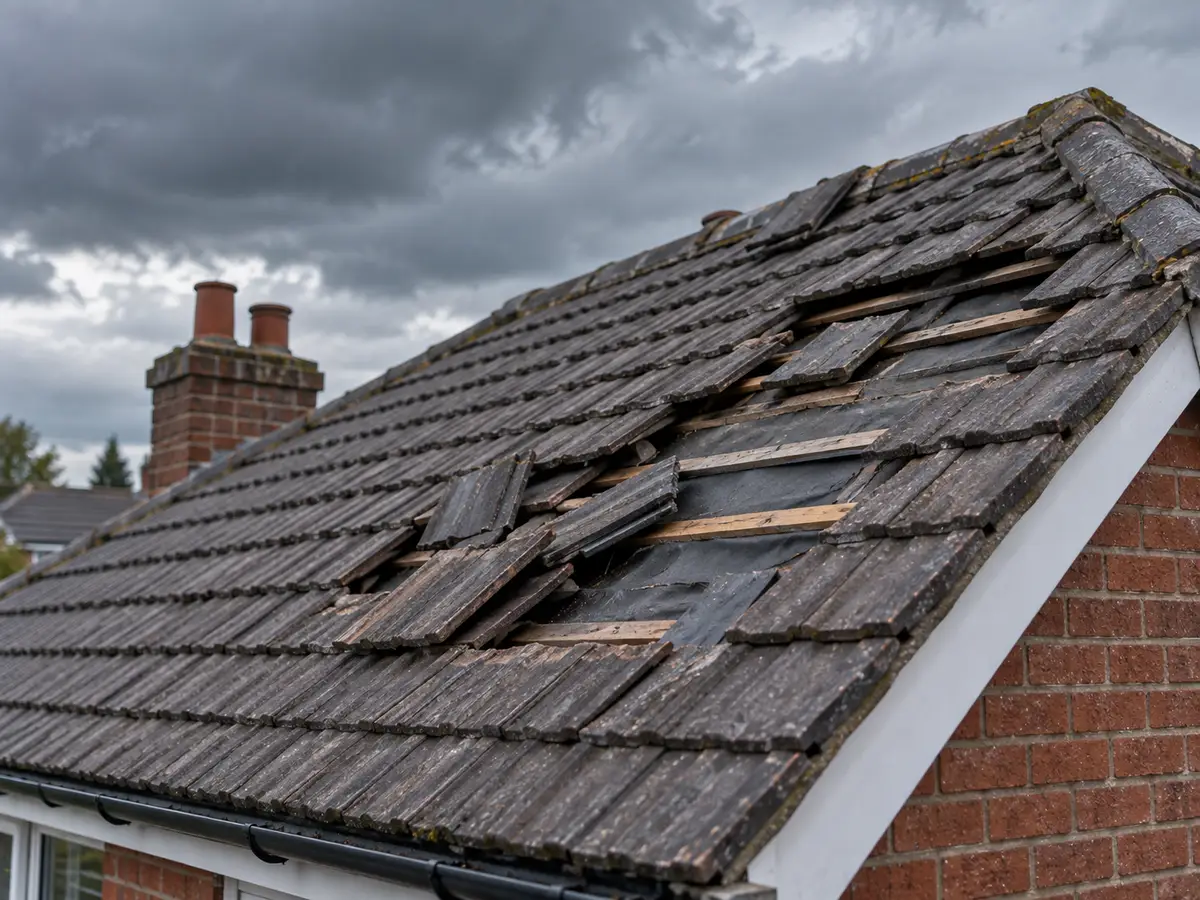
- Gaps or dark patches in the roofline pattern where tiles or slates look missing or displaced, compared with the surrounding area.
- Guttering that's sagging, detached at a joint, or hanging away from the fascia at an angle it wasn't before.
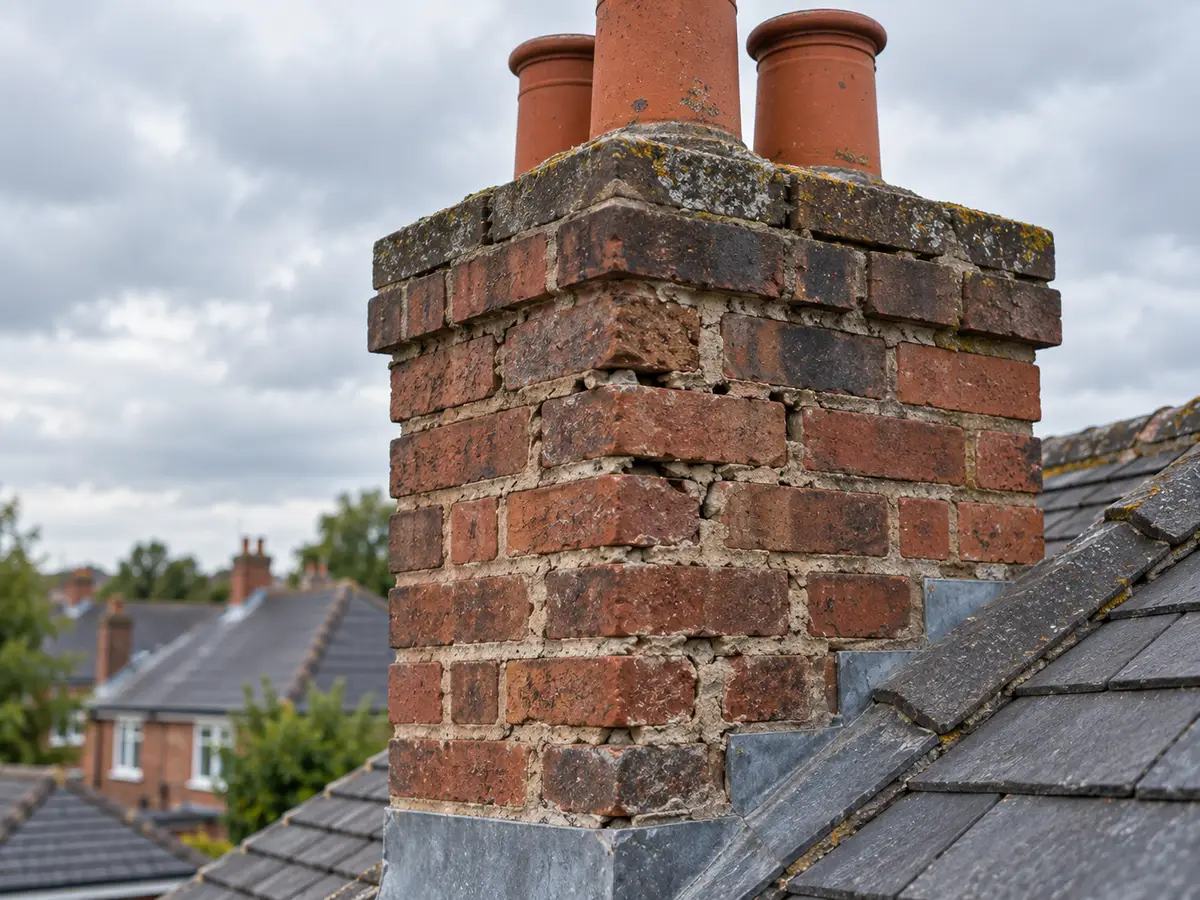
- A chimney stack that looks like it's leaning differently, has visibly lost pots, or has fresh cracks or gaps in the pointing.
- Flashing (the metal strip sealing joins, often around a chimney or roof valley) that looks lifted, curled, or missing a section.
- New staining on external walls below roof level, which can indicate water now tracking down from a damaged section above.
- For a flat roof visible from an upstairs window, any obviously lifted edges, flapping material, or debris sitting on the surface.
If any of this sounds familiar as a general early-warning list rather than something storm-specific, that's because it overlaps with our general signs of roof repair guide — the difference here is timing and cause. Storm damage tends to appear suddenly, all at once, and clearly tied to a specific event, rather than developing gradually over months.
What storm damage typically looks like
Common storm damage signs and rough urgency
| Sign | What it can indicate | How urgent |
|---|---|---|
| Missing tiles or slates, gap visible from the street | Direct exposure to the elements at that spot; a route for water to get in | High — worth booking in promptly |
| Guttering pulled away from the fascia or hanging loose | Wind loading has overcome the fixings; water is likely now missing the gutter entirely | Moderate–high, especially before the next heavy rain |
| Cracked or displaced chimney pot, or fresh mortar debris below the stack | Wind has loosened pointing or the pot itself | Moderate–high depending on how unstable it looks |
| Lifted or missing flashing around a chimney or valley | A common storm failure point; frequently the first place a leak develops afterwards | High — a common precursor to a leak |
| New damp patch or ceiling staining appearing after the storm | Active water ingress through storm-damaged covering | High — treat as a priority |
| Debris (tile fragments, moss, small branches) scattered in the garden or gutters | General evidence of wind disturbance, sometimes without an obvious specific source | Low–moderate — worth a wider check even if the source isn't obvious |
It's genuinely common for the visible sign and the underlying damage not to line up exactly — a bit of debris in the garden doesn't always trace back to one obvious gap, and a small ceiling stain doesn't always sit directly under the actual point of entry. That's normal, and it's exactly the kind of thing a roofing professional's assessment is for, not something you need to work out precisely yourself.
Debris, fallen branches and neighbouring trees
Fallen branches and trees add a layer of complexity beyond the roof itself. If a branch or tree has come down onto the property, don't attempt to move or clear it yourself if there's any doubt about its stability or weight — this is a job for someone with the right equipment, and in many cases your insurer will want to arrange this rather than have it done informally.
If the tree belongs to a neighbouring property, it's worth knowing responsibility can be more nuanced than "whoever's tree it is pays for everything" — the position depends on factors like whether the tree was known to be unsafe beforehand, and is ultimately a matter for insurers (and occasionally solicitors) to resolve between them rather than something to negotiate informally on the day. Photograph the situation clearly, including which property the tree or branch originated from if that's identifiable, and let your insurer take it from there.
Documenting it properly, in case you need to claim
Whether or not you end up making an insurance claim, thorough documentation costs nothing to do now and is genuinely hard to reconstruct convincingly later. Storm damage in particular is often more straightforward to establish than gradual wear, precisely because it's tied to a specific, datable event — which is exactly the detail worth capturing clearly while it's fresh.
- Photograph the roofline, guttering, chimney and any debris from several angles, including at least one wide shot that shows the whole roof slope for context.
- Note the date, and roughly what time the worst of the storm or high winds hit, if you can recall it or check a weather record.
- Keep any receipts for immediate emergency measures, such as a tarpaulin or temporary repair, since these are sometimes claimable.
- If a specific named storm was reported in the media, note its name — insurers sometimes ask for this and it can help establish the cause clearly.
- Avoid clearing away debris from the garden or roof area until you've photographed it, even though the instinct to tidy up quickly is understandable.
- Check your home insurance policy for what's covered and any claim time limits — policies vary, and RoofEnquiry isn't able to advise on individual cover, so this is worth confirming directly with your insurer.
Temporary protection vs a permanent repair
In a genuine emergency — an active leak, a large gap exposed to the weather, materials at real risk of coming down further — a roofing professional may fit a temporary measure such as a tarpaulin sheet secured over the affected area, with a full permanent repair to follow once conditions and access allow. This is a normal, sensible approach immediately after a storm, particularly if more bad weather is forecast before a full repair can safely be carried out.
If a temporary fix has been put in place, it's worth asking clearly when the permanent repair is expected and making sure it's actually booked in, rather than left open-ended. A tarpaulin is a genuinely useful short-term measure, not a long-term solution, and a follow-up that gets forgotten is one of the more avoidable frustrations people report after storm repairs.
Is storm damage covered by insurance?
Many UK home insurance policies do cover storm damage, since it's typically classed as a sudden, identifiable event rather than gradual wear and tear — but exact terms, excesses and what counts as "storm damage" for the purposes of a specific policy vary between insurers. Some policies set a minimum wind speed threshold for a claim to qualify, for instance, which isn't something you'd generally know without checking your own paperwork.
One detail worth knowing regardless of your policy specifics: insurers generally expect reasonable steps to prevent further damage once you're aware of a problem, which is part of why temporary protective measures (like a tarpaulin) are usually looked on favourably rather than treated as interfering with a claim. Leaving an exposed area unprotected while waiting weeks for a decision is more likely to cause a dispute than a sensible, documented temporary fix.
Why timing and pricing can shift after a widespread storm
A single property with an isolated problem is a different situation to a storm that's affected many roofs across the same area at once. After significant, widespread weather events, demand for roofing work in the affected area can rise sharply for a period, which sometimes means genuine emergencies are prioritised ahead of non-urgent bookings, and timescales for routine work can extend a little until things settle.
This isn't something RoofEnquiry or any individual roofer controls — it's simply a reflection of demand and supply during and after severe weather, and it's honest to say upfront rather than promise a response time that might not hold during an unusually busy period. If your situation is genuinely urgent, selecting 'Emergency / ASAP' on an enquiry signals that clearly to anyone reviewing it.
The same pattern can apply to pricing, in the sense that our cost guide already covers for seasonal demand generally — a period of widespread storm-related work across an area is one version of the high-demand periods that guide describes, and it's part of why a quote gathered during or immediately after a major storm might land at the higher end of a typical range rather than the lower end.
A few common myths about storm damage
- "If I can't see anything from the ground, the storm didn't cause any damage." Not necessarily — some storm damage, particularly to flashing, ridge tiles, or the upper sections of a chimney, isn't always visible from a standard ground-level angle. A one-off check after a significant storm is worth doing even without an obvious visible sign.
- "Storm damage always needs to be fixed immediately, that same day." Genuine emergencies (active leaks, unstable debris, exposed gaps) do need prompt attention, but plenty of storm damage — a slightly displaced tile with no active leak, for instance — is a straightforward repair that's reasonable to book in over the following days rather than treat as a middle-of-the-night crisis.
- "A small amount of debris means the whole roof needs replacing." Debris on the ground is a sign worth investigating, not a verdict on the roof's overall condition — it's often traceable to a small, specific, repairable area.
- "Once the repair's done, that's definitely the end of it." It's worth keeping an eye on the affected area for a couple of weeks afterwards, the same as with any repair, since residual dampness or a related issue nearby can occasionally take a little longer to fully show itself.
If you're renting or managing a rented property
If you're a tenant, the roof itself is generally the landlord's responsibility to repair, though the exact position depends on your tenancy agreement. The safety checks and documentation steps in this guide are worth doing regardless of whose responsibility the repair is, alongside reporting the damage to your landlord or letting agent promptly, ideally in writing so there's a clear record of when it was reported.
If you're a landlord or managing a rented property yourself, the same safety-first approach applies, and submitting an enquiry is a straightforward way to get an assessment moving once the immediate safety checks are done.
After the storm passes: the days that follow
- Keep an eye on any ceilings or walls near where you spotted external damage, even if nothing's showing yet — some water ingress takes a little time to become visible indoors.
- If more wind or rain is forecast before a permanent repair is arranged, check that any temporary protection is still secure.
- Keep your photos and notes together in one place, whether or not you end up needing them for a claim.
- Once repair work is booked, ask roughly how long it's expected to take, so you have a realistic idea of the timeline rather than an open-ended wait.
It's also a reasonable moment, once the immediate issue is sorted, to think about whether a fuller roof inspection is worth having — not because a storm always reveals a wider problem, but because it's a natural prompt to get a proper look at the roof's overall condition rather than only the specific storm-related fault.
Reducing the impact of the next storm
- Keep gutters clear — a gutter already blocked with debris is more likely to be overwhelmed or pulled loose when heavy rain and wind arrive together.
- Don't leave small, known issues unaddressed — a tile that was already loose before a storm is far more likely to come off entirely once high winds arrive.
- Keep an eye on overhanging branches near the property, and have anything that looks genuinely risky assessed by a tree specialist rather than waiting for the next storm to make the decision for you.
- After any significant storm, make a quick ground-level check a habit even when nothing seems obviously wrong — it costs a few minutes and catches the damage that isn't dramatic enough to notice on its own.
Our roof inspection checklist includes a seasonal routine that folds a post-storm check into a wider ongoing habit, rather than treating storm damage as something that only ever needs a one-off reaction.
Getting it looked at
Once the safety checks are done and you've got photos and notes together, describing what happened — roughly when the storm hit, what you've noticed, and any photos — gives a roofing professional a genuinely useful starting point before they've even visited the property.
Frequently Asked Questions
How soon after a storm should I check my roof?+
As soon as it's genuinely safe to do so — once the worst of the wind has passed and it's daylight. A calm ground-level walk-around is the right first step; there's no need to rush outside while conditions are still severe.
Is it normal for storm damage to only show up a few days later?+
Yes — some damage, particularly to flashing or the upper sections of a roof, isn't always immediately visible from the ground, and a resulting leak can sometimes take a little time to show as a ceiling stain. A follow-up check a few days after the storm is a reasonable habit.
Will my insurance premium go up if I make a storm damage claim?+
This varies by insurer and policy, and isn't something RoofEnquiry can advise on. It's a reasonable question to ask your insurer directly when discussing a potential claim.
What counts as a 'storm' for insurance purposes?+
This is defined differently between insurers, sometimes with a minimum wind speed or specific criteria written into the policy. Check your own policy documents or ask your insurer directly, since general guidance here can't reflect the exact wording of your cover.
Should I get a repair done before or after an insurance claim is approved?+
For genuine emergencies (active leaks, unsafe debris), reasonable temporary protective measures are generally expected and shouldn't cause issues with a later claim — but for non-urgent permanent repair work, it's worth checking with your insurer about their process before committing to work, since some insurers prefer to inspect or approve first.
How do I know if debris in my garden actually came from my roof?+
It's not always obvious, and that's fine — photograph it and mention it when describing the problem. A roofing professional assessing the roof can usually confirm whether it matches damage they find.
A neighbour's fence or shed was damaged by something from my roof — what should I do?+
This is generally a matter between insurers (yours and, where relevant, theirs) rather than something to resolve informally on the day. Document what happened with photos and speak to your insurer about next steps.
Can storm damage make an existing small roof problem worse?+
Yes — a tile or section of flashing that was already slightly loose is far more likely to fail completely under storm-force wind than in calm conditions, so what looks like sudden storm damage sometimes has a pre-existing, smaller issue behind it.
How quickly can storm damage actually be looked at?+
This depends on the roofing professionals covering your area and current demand, which can be higher than usual immediately after a widespread storm. Selecting 'Emergency / ASAP' on an enquiry helps signal genuine urgency.
Is it worth checking my roof even if I can't see any obvious damage?+
Yes, if there's been a significant storm — a brief ground-level check costs little and can catch less obvious signs like a subtly lifted section of flashing or debris tucked in a gutter that isn't visible at a glance.
Do I need to report minor storm damage, or only serious damage?+
It's reasonable to have even minor damage looked at, since a small storm-related fault left unaddressed can develop into a leak before the next spell of bad weather. There's no strict threshold — if in doubt, describing it in an enquiry costs nothing.