Scaffolding & Access for Roof Work: What to Expect and What It Costs
By RoofEnquiry Editorial · Updated 24 September 2026 · 10 min read
Quick answer
- Access equipment is chosen based on the height, duration and nature of the job, not just personal preference — a single tile might need a ladder, a full re-roof almost always needs proper scaffolding.
- Scaffolding is often one of the largest single costs on a quote precisely because it protects everyone on site, not because it's being used to inflate the price.
- Erecting scaffolding on a public pavement can require a licence from the local council, and this is worth confirming is being handled rather than assumed.
- If a quote for anything beyond a very minor repair doesn't mention access equipment at all, that's worth asking about directly before work starts.
The cost line that raises the most questions
Scaffolding is one of the more commonly questioned items on a roofing quote, and it's easy to see why — it can add a meaningful amount to the total cost of a job that, described in a sentence, sounds small: "a few tiles need replacing" doesn't obviously call to mind a structure being built around the entire side of a house. But access equipment isn't an optional extra tacked onto a quote to pad it out. It's chosen based on genuine, fairly predictable factors, and understanding those factors makes it much easier to judge whether a specific quote's approach to access makes sense for your job.
This page covers what actually decides which type of access equipment a job needs, what's involved in getting scaffolding up (and down again), roughly what it costs, and the safety reasoning behind why this generally isn't an area worth trying to economise on.
It's also worth saying plainly why this page exists alongside the rest of the site: access equipment quietly sits underneath almost every other guide here. Chimney work, a full re-roof, skylight replacement, even wildlife-proofing work all depend on safe access being arranged properly first — it's rarely the headline of a quote, but it's frequently the thing that determines how the job is actually priced and scheduled.
What decides the access method
Factors that determine access equipment
| Factor | Why it matters |
|---|---|
| Height of the roof | Single-storey properties have far more straightforward, lower-risk access options than a two- or three-storey property |
| How long the job takes | A five-minute fix and a five-day re-roof carry very different justifications for the time and cost of erecting full scaffolding |
| Where on the roof the work is | A repair near the eaves is a different proposition to one at the ridge, or on a steep or complex roof shape |
| Whether materials need to go up and down repeatedly | A full re-roof involves constant material movement, which needs safe, repeated access rather than a single trip up |
| Roof pitch and condition | A steep or unstable roof surface generally rules out simply working directly on the tiles without additional support |
No single factor decides it alone — a roofing professional weighs these together for your specific job, which is why two seemingly similar repairs on different properties can be quoted with different access methods.
The main types of access equipment
- Ladders — suitable for very limited, low-risk access, such as a quick inspection or a repair confined to right at the eaves of a single-storey building. Not appropriate for extended work or anything requiring both hands free for a sustained period.
- Roof ladders and crawl boards — hooked over the ridge to distribute weight and provide a stable working surface directly on the roof slope itself, used for short, contained jobs on a roof that's otherwise sound enough to support them.
- Tower scaffold (mobile scaffold towers) — a freestanding, wheeled or static structure suited to jobs concentrated in one area, offering a stable working platform without the time and cost of a full scaffold.
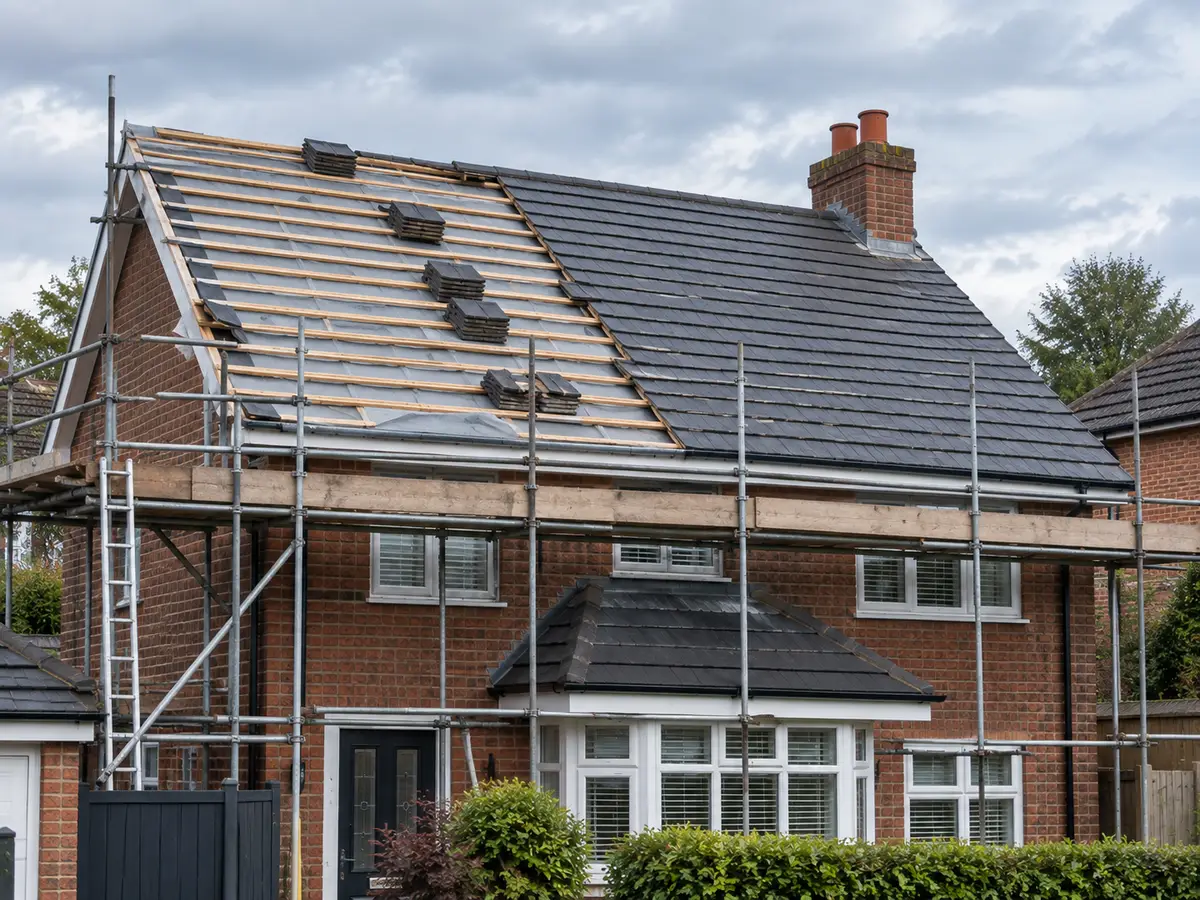
- Full scaffolding — erected around some or all of the property, providing continuous safe access across the whole working area, and the standard choice for full re-roofs, extensive repairs, or any job expected to take several days.
- Cherry pickers / mobile elevating work platforms (MEWPs) — used less often on standard domestic roofs, but sometimes the practical choice for an isolated, hard-to-reach feature like a chimney where full scaffolding isn't proportionate to the job.
We'd always advise against a homeowner attempting any of this themselves — whether that's borrowing scaffolding, working from a domestic ladder for anything beyond a brief look, or assuming a job "looks small enough" to skip proper access. This is one of the more consistent pieces of advice across our leak guide, our moss guide and our wildlife guide, and it applies here for the same reason: working at height is a genuinely common source of serious injury, and it's exactly the kind of job a professional has the right equipment and training to do safely.
It's also worth understanding that these options aren't simply interchangeable at the professional's discretion — UK health and safety regulations covering work at height require the method chosen to be proportionate to the actual risk and duration involved, which is exactly why a reputable roofing professional won't offer to "just use a ladder" for a job that genuinely calls for scaffolding, even if a ladder would technically be quicker and cheaper to set up.
Scaffolding on terraced and semi-detached properties
Terraced and semi-detached properties add a layer of complexity that a detached house doesn't have, simply because scaffolding often needs to extend across or alongside a shared boundary to reach the relevant part of the roof properly. This is worth planning for specifically rather than discovering midway through a project.
- A shared or party wall roof — such as a hip or valley shared between two adjoining properties — may need scaffolding that touches both properties, which is worth discussing with the neighbour directly and early.
- Access along a shared side return or narrow gap between properties can restrict which type of scaffold is practical, sometimes ruling out a full scaffold in favour of a tower or alternative access method.
- Where work genuinely affects a shared structure rather than just needing scaffolding to pass over a boundary, formal party wall procedures may apply — a separate legal process from the roofing work itself, and worth asking about if your property is attached to a neighbour's.
- Good early communication with neighbours about timing, noise and access tends to prevent the majority of friction that otherwise crops up once scaffolding is already in place.
What's actually involved in getting scaffolding up
- A site assessment to confirm ground conditions, boundaries, and exactly what access is needed for the specific job.
- Checking whether a pavement or highway licence is needed from the local council, if the scaffold needs to stand on public land rather than entirely within the property boundary.
- Confirming access with neighbours where scaffolding needs to extend over or alongside a shared boundary — a courtesy that also avoids disputes once work is under way.
- Erecting the scaffold itself, typically taking the best part of a day for a standard domestic job.
- A safety inspection once erected, and at regular intervals (by law, at least every seven days) while it remains in place for ongoing work.
- Taking the scaffold down once work is complete and the final inspection has signed it off.
That pavement licence point is worth flagging specifically, since it's easy to overlook. If scaffolding needs to stand on a public footpath rather than entirely on private land, the council generally needs to be notified or a licence obtained, and it's worth confirming with whoever is doing the work that this has been considered rather than assuming it's automatically covered.
What to check in a quote that includes scaffolding
- Whether scaffolding is itemised separately or bundled into the overall project price — neither approach is inherently better, but it's worth knowing which you're looking at when comparing two quotes.
- Whether the scaffolding company (if a separate specialist rather than the roofer's own crew) carries its own public liability insurance, distinct from the roofing contractor's own cover.
- Roughly how long the scaffold is expected to remain up, since this affects both the hire cost and how long your property will have it in place.
- Whether a pavement licence is needed for your specific property and, if so, who's responsible for arranging it.
- What happens if the job overruns — whether extended scaffold hire is charged separately or was already accounted for in the original quote.
None of these questions are awkward to ask, and a professional who's used to fielding them will simply answer directly. A vague or evasive response to a straightforward access question is arguably a more useful signal than the specific pricing itself — see our guide on choosing a roofer for more on reading those kinds of signals generally.
Why it's rarely worth trying to avoid
It's a reasonable instinct to want to minimise cost on any job, but scaffolding is one of the areas where cutting corners carries a disproportionate downside compared with the saving involved. Working at height without appropriate access equipment is consistently one of the leading causes of serious injury in construction and home maintenance work generally, and that risk applies just as much to a seemingly quick job as a lengthy one — arguably more, since a rushed short job is exactly when corners are most tempting to cut.
There's also a quality dimension beyond safety: a stable, properly erected working platform generally leads to better workmanship than someone stretching, balancing, or rushing to minimise time spent in an awkward or unstable position. A job done from secure access is more likely to be done thoroughly the first time, which matters when the alternative is a repeat visit for something that wasn't quite finished properly.
General UK price ranges
Indicative UK access equipment costs
| Access type | Typical UK range | What it usually includes |
|---|---|---|
| Tower scaffold hire (short job) | £150 – £400 | Erected, used for a few days, and taken down for a contained repair |
| Full scaffolding (standard domestic property) | £600 – £1,500 | Erected around the relevant elevation(s), inspected, and left in place for the duration of the work |
| Full scaffolding (larger or more complex property) | £1,200 – £3,000+ | As above, scaled for a bigger property, multiple elevations, or an extended project timeline |
Indicative UK ranges only, excluding VAT unless stated. Actual cost depends on property size and shape, how long the scaffold needs to stay up, access restrictions, and whether a pavement licence is needed — see {{guide:how-much-does-roof-repair-cost-uk|our full cost guide}} for the wider set of roofing price ranges these sit alongside.
On a full re-roof, scaffolding cost is generally already folded into the overall project quote rather than itemised as a separate decision — worth remembering when comparing quotes, since one contractor pricing it separately and another bundling it in doesn't necessarily mean one is cheaper on access than the other.
Property shape has a bigger effect on the final figure than most homeowners expect. A simple rectangular elevation is straightforward and relatively quick to scaffold; a property with bay windows, an uneven roofline, multiple elevations needing access, or restricted space to erect the structure at all, can push cost towards the higher end of the range even where the roofing job itself is fairly modest. This is one of the reasons two seemingly similar repairs on different properties can come back with noticeably different total quotes, even when the roofing work itself is priced almost identically.
Making the most of scaffolding once it's up
Given how much of the total access cost goes towards simply erecting and dismantling the structure, it's worth thinking about whether anything else on the property could reasonably be done at the same time, while that access is already available. This is the same logic covered in our guttering guide and our wildlife guide — a gutter clear, a chimney check, or fitting bird-proofing mesh are all far more cost-effective bundled into an existing scaffold hire than paid for as a separate access job later.
This is also a sensible moment to think about exterior jobs that aren't strictly roofing at all but benefit from the same access — repainting fascias and soffits, clearing a chimney flue, or checking an aerial or satellite dish fixing. None of these need to be arranged through the same contractor, but flagging them early means whoever is planning access can factor in a slightly longer scaffold hire if it genuinely saves a second erect-and-dismantle cycle later.
Getting it looked at
Whether you're trying to understand a specific quote, wondering whether a job genuinely needs scaffolding, or simply want to plan ahead for an upcoming project, the details that help most are the height and type of the property, roughly what work is needed, and how long it's expected to take. Our guide on what information to give a roofer covers this in more general detail.
Frequently Asked Questions
Does every roof repair need scaffolding?+
No — a very minor, contained repair on a single-storey property might only need a ladder or a short-term tower scaffold. Full scaffolding becomes the standard choice for larger jobs, multi-storey properties, or anything expected to take several days.
Why is scaffolding sometimes the most expensive part of a small job?+
Erecting and dismantling scaffolding takes broadly similar time and labour regardless of how small the actual repair is, so on a genuinely minor job, the access cost can end up disproportionate to the repair itself. This is worth asking about directly if a quote looks scaffolding-heavy for a small job.
Do I need permission to have scaffolding on my property?+
Not for scaffolding entirely within your own property boundary in most cases, but if it needs to extend over a public pavement or road, a licence from the local council is usually required — worth confirming this has been arranged.
How long does scaffolding usually stay up?+
This depends entirely on the job — a short repair might only need scaffolding for a few days, while a full re-roof could need it up for one to two weeks or more. It should come down as soon as the work and final inspection are complete.
Is it safe for a roofing professional to work without scaffolding on a small job?+
For genuinely minor, low-risk work, a ladder or roof ladder can be an appropriate and safe choice — the point isn't that scaffolding is always required, but that the access method should match the actual risk and duration of the job.
Can I ask for scaffolding to be removed sooner to save cost?+
It's a reasonable question to ask, but scaffolding should stay up until the work is genuinely finished and signed off — removing it early to save cost risks needing it put back up again if further work turns out to be needed.
Does scaffolding need to be inspected while it's up?+
Yes — scaffolding used for ongoing work is subject to regular safety inspections, typically at least every seven days, alongside an initial inspection once it's first erected.
Should I ask my neighbours before scaffolding goes up?+
It's good practice, particularly if the scaffold will extend over or alongside a shared boundary, even where it's not strictly required. A brief heads-up avoids disputes and is generally appreciated.